Showing posts with label Massachusetts. Show all posts

Wednesday, May 3, 2017

Is Boston Racist?

By now you've heard about the Adam Jones incident. Twenty-four hours later, the topic was still the news story in baseball, unspooling new sub-threads and inspiring much larger debates (anyone still think sports isn't political?). They'll move on, eventually. But in my hometown of Boston, the incident has exposed an ugly truth and forced a great deal of introspection that will—or at least should—linger.

We Bostonians have an inferiority complex, and one of our most tender spots is when the rest of the country plays the "Boston is racist" card. A cosmopolitan, liberal city, Boston certainly doesn't see itself that way—yet at the same time anyone with a more than passing connection to the city carries around the hidden shame of the city's violent resistance to busing in the 1970s. Within my lifetime, the Boston media, city leaders, and the collective masses were all guilty of a rush to judgment about the murder of Carol Stuart, a young suburban mother-to-be killed not by a black carjacker, but by her white husband. When an African American baseball player is called the N-word at Fenway Park, it's impossible not to draw the connection.

My first impression was optimism that our city was at least viewing Jones's assault with open eyes. Instead of attacking Jones or ignoring the story entirely, the Boston elite faced up to it. The Boston Globe led with the story all day on its website, and Mayor Marty Walsh and Governor Charlie Baker both issued swift statements of condemnation early this morning. Walsh, an Irish Catholic from Dorchester (still a demographic profile that's more associated with Trumpian intolerance than the bleeding-heart inclusiveness of the Cantabrigian university student), had particularly strong words: "If they claim to be a sports fan, they’re not a sports fan—nothing but a racist." Boston finally seemed to be acknowledging that, yes, it had a problem with racism it desperately needed to fix.

There was also a common thread in Walsh's and Baker's words, as Globe columnist RenĂ©e Graham pointed out: "This is not what Massachusetts and Boston are about." So maybe the sensitivity remained. Walsh and Baker were acknowledging that Boston has racist elements, but also insisting that, at its core, Boston was a welcoming and tolerant place. Well, OK. They're politicians—they are going to believe (or at least say they believe) the best about their constituents. But it's worth noting that Walsh's administration last year kicked off a series of town halls "aimed at bringing conversations about racism, healing, and policy work into all Boston neighborhoods." At one of the meetings, Walsh said, point-blank, "Boston has an issue with racism." Whether he thinks "racist" or "tolerant" is a more fitting adjective for Boston in 2017, Walsh clearly understands that there is still racism left to overcome in the city.

That was the city's elite, however. How did the hoi polloi react? Twitter unfortunately became the instrument by which this was measured, and the results were mixed at best. Liberal baseball Twitter pounced upon this tweet by NFL writer Albert Breer that summed up the denial of many Bostonians: "Is it horrible to want some proof? I dunno. I've probably been to 200 games at Fenway in my life. Never heard a slur yelled at a player." (Never mind that Jones had no reason to lie, and Boston fans have a reputation for racial taunting among African American athletes.) However, I saw just as many tweets from Bostonians (not to mention my own reaction) expressing their unqualified disgust for their fellow Red Sox fans in the bleachers Monday night, so I hardly think Breer's viewpoint is universally held here. Twitter attracts a broad element of society, including its dregs. You can find pretty much any opinion on there if you're looking for it. Overall, I think Boston took responsibility for the incident, as it should have—as it must have if we're going to make sure it isn't repeated.

It would be nice if that were the final word. But that inferiority complex is acting up again, because even those of us who own up to the racism of drunk Red Sox fans can't help but get defensive about the resurgent blanket narrative that "Boston is racist." We object to the very logic that people accuse us of: that our entire community should be stereotyped by the actions of a foolish few. This is unfair, of course; most people in Boston are not racist, as illustrated most recently by the classy standing ovation Red Sox fans gave Jones at Tuesday's game. The ovation did not undo what happened to Jones, but neither does what happened to Jones negate the ovation. Clearly, Boston has a racist underbelly, but what percentage of a city's residents have to belong to that fringe in order to say the city as a whole is racist? One bigot does not a racist city make, but a place doesn't need to be 100% pure-grade racist either.

This is something outsiders fail to realize when they smugly ask how Boston can be considered one of the most liberal cities in America while still struggling with racism. The two facts have little to do with each other. Massachusetts isn't a monolith where 100% of its citizens are latte-sipping progressives who nonetheless harbor secret racial animosities. Yes, it's true, 60% of Bay Staters voted for Hillary Clinton in November, more than 45 other states. But that means 33% voted for Donald Trump—at least some of whom were motivated by prejudice. (Trump also won the state handily during the primary.) And yes, some Democrats are racist as well, even if only in subtler ways. It was in dark blue Cambridge that someone called 911 to report that famed African American Studies scholar Henry Louis Gates looked suspicious as he attempted to open the jammed front door of his Harvard Square townhouse. These uncomfortable truths do nothing to change the fact that Massachusetts has been at the forefront of the progressive movement (inaugurating, among other things, same-sex marriage and Obamacare), including on issues of racial justice, which aren't abstract to them either: Massachusetts was home to the first black U.S. senator and the second black governor ever to be elected.

The question is whether Boston is racist with tolerant elements or tolerant with racist elements. And I honestly don't know which is correct. Boston hasn't earned the benefit of the doubt with its history; in addition to the nationally publicized busing crisis, Celtics players including the great Bill Russell confronted blatant racism here during the 1970s and '80s. But Boston is also a very different city than it was back then, and the racist reputation it earned 40 years ago gives us only an incomplete picture of the present day. The Jones incident did elicit a disturbing comment out of fellow African American ballplayer C.C. Sabathia, who said he has "never been called the N-word" anywhere but Boston (albeit not since before 2009); "when you go to Boston, expect it." Former MLB outfielder Vernon Wells chimed in that he "was only warned about two stadiums where racially motivated comments could occur...Fenway was one." In 2007, Gary Matthews Jr., then of the Angels, called Boston "one of the few places where you hear racial comments." But then that reminds you that other fan bases have brazenly engaged in bigotry as well. Athletics outfielder Rajai Davis—who has never played for the Red Sox and has no apparent reason to hold back about the city—said Tuesday, "It's not a Boston problem. It's a national problem."

And there's another confounder. As we learned seemingly nonstop for eight years after we supposedly overcame it by electing Barack Obama, the United States is still infested with latent racism. Other cities—Los Angeles, Chicago, Washington, DC—have racial records as troubled as Boston's. Heck, it's not even limited to this country—the last time Adam Jones was subjected to racial slurs, it was in Toronto during last year's Wild Card game. All this makes it even harder to determine whether Boston is a particular hotbed for bigotry or merely part of a wider problem, from which even coastal liberal bastions are not safe. Of course, the fact that other cities are racist too doesn't make Boston not racist.

So is Boston racist? Ultimately, it's semantic. I have a hard time disagreeing with someone who says Boston is racist according to a certain definition of the term. Personally, though, I would say instead that it has a race problem. So does the entire country—that shouldn't be controversial. Is Boston's worse? I don't know. It certainly was historically; it might still be. We've made enough progress since the 1970s that we're now in a gray zone where the slurs directed at Adam Jones could plausibly be either the residue of Boston's prejudicial past or a symptom of a national trend. But it also doesn't really matter, because neither is good enough. Even after Monday night's vulgarity, I love my hometown. I love it because of all the things it does right—ranked at or near the top in education, medical care, economic vitality. With that pedigree, there's no excuse for having even nationally average levels of racism. We are the City on a Hill, meant from our founding to be an example for the rest of the world to strive toward. The same self-righteousness that makes Bostonians so protective and such easy targets for the rest of the country should be a unique motivator to clean up our act. If you think, in the face of so much evidence, that Boston is already perfect, you're interpreting this Hub of the Universe thing wrong. Instead, it's the nagging conviction that we should be better that propels us there.

Tuesday, August 16, 2016

Curt Schilling's Political Career Is Doomed

In 2009, after the death of longtime Massachusetts Senator Ted Kennedy, Curt Schilling publicly toyed with the idea of running for the seat. Despite receiving plenty of encouragement from elites and social-media followers alike, the just-retired hurler declined to seek the Republican nomination, saying "it just did not make sense." Instead, the GOP turned to little-known State Senator Scott Brown to face Attorney General Martha Coakley. The rest is history.

In choosing not to run, Schilling probably made the worst decision of his still-non-existent political career. As Brown proved, conditions were perfect for a Republican upset in blue Massachusetts. The low-turnout environment of a special election allowed the most passionate, anti-Obama voters to have a disproportionate say in the outcome. The GOP was gifted a gaffe-prone opponent in Coakley. And the 2010 election took place before most of Schilling's controversial political statements. Like Barack Obama (to his benefit) and Chris Christie (to his detriment) before him, Schilling should have struck while the iron was hot.

Instead, a full eight years later, he has apparently suddenly decided he does want to run for office after all. After slyly hinting at a potential presidential run on Facebook last week, Schilling has now revealed that he is considering running for Senate in 2018 against Elizabeth Warren—the liberal hero who wrested Kennedy's seat away from Brown in 2012. "I would like to be one of the people responsible for getting Elizabeth Warren out of politics," Schilling said during an interview on WRKO. "She’s a nightmare. The left’s holding her up as the second coming of Hillary Clinton, Lord knows we don’t need the first."

But here's the reality: Schilling, a Republican, would stand no chance in such a campaign. Massachusetts remains a deep blue state; in top-of-the-ticket races since 2008, Democrats have beaten Republicans by an average of 55.6% to 41.7%. While Republicans like Brown and Governor Charlie Baker have beaten the odds and won statewide in recent years, Brown did so in a special election with just 48% turnout, while Baker did it by overperforming in Yankee Republican strongholds like Wellesley and Newton—moderate, affluent towns unlikely to respond to Schilling's brand of bombast.

And while Brown and Baker were running for open seats—and both against the polarizing Coakley—Schilling in 2018 would be facing an incumbent senator with $3.8 million in the bank and a 61/27% approval/disapproval rating. The last time Schilling was polled in Massachusetts, in 2009, he had a 29% favorability rating and a 39% unfavorability rating—again, before his recent controversial statements. To give a sense for where Schilling's popularity might stand today, in Rhode Island in 2013 his numbers were 9% favorable and 74% unfavorable. Of course, Rhode Islanders are probably better acquainted with Schilling's 38 Studios debacle—although, if Schilling does run in Massachusetts, Bay Staters are going to hear about it very quickly as well.

Massachusetts Republicans will probably enjoy favorable tailwinds in 2018, with an unpopular Hillary Clinton likely to be president and a popular Baker likely to be coasting to re-election. But Warren is a perfect fit for liberal Massachusetts, and the Trumpian Schilling decidedly is not. If he runs, Schilling will have no better luck getting elected to the U.S. Senate as he has had getting elected to the Baseball Hall of Fame. The deserving Schilling—who remains a phenomenal baseball player even as he is a terrible politician—should focus on getting elected in Cooperstown instead.

Tuesday, January 26, 2016

How Trump Dominates in America's Bluest State

On a recent trip into rural Massachusetts, I spotted multiple Donald Trump signs. The conservative mogul has held three rallies in the Bay State and drawn thousands of spectators each time. And in primary polls of the state, Trump leads by an even bigger margin—an average of 25 percentage points!—than he does in the rest of the country. Against all odds, Massachusetts loves Donald Trump.

This flies in the face of the popular view of Massachusetts as a liberal bastion, even for Republicans. For decades, Massachusetts Republicans have built a reputation as moderate, socially liberal, pro-business consensus-seekers. But while this may accurately describe members of the Massachusetts Republican establishment (such as Governor Charlie Baker), it’s an outdated way of looking at the Republican electorate in the state.

Since 2010, Republican candidates for president, senator, or governor have averaged 44.1% of the vote in Massachusetts—a more vocal minority than you might assume. More than one breed of Republican is needed to build a coalition of this size. Broadly speaking, the Massachusetts GOP today relies on three types of voters: fiscally conservative business elites, socially conservative blue-collar workers, and rural, anti-government culture warriors. These last two groups are Trump’s sweet spot.

The state’s financial elite—and like-minded, pro-business voters—were historically loyal Republicans. From 1920 through 1956, their predictability in presidential elections made Massachusetts an average of 2.1 points more Republican than the nation as a whole. But the election of one of their own in 1960, coupled with the rise of social conservatism from Barry Goldwater through George W. Bush, compelled many of these moderates to reconsider their affiliation.

Today, educated, upper-class Bay Staters are better considered independents and often split their tickets. Most are socially liberal and usually vote for Democrats in presidential elections as social issues have dominated the national stage. But they do occasionally vote for Republicans in state elections, where social issues less often drown on economic ones. These voters were largely responsible for Baker’s election in 2014.

As a coarse, bomb-throwing populist, Trump holds little appeal to these voters. But he benefits from the fact that the wealthy are now a smaller part of the state’s Republican base than ever before. The public faces of the Massachusetts Republican Party, from Baker to former Governor Mitt Romney to members of the state legislature, may remain pulled from this pool of elites, but they are increasingly feeling the heat from conservative activists.

Similarly, as the state GOP has bled establishment voters, its electorate has been distilled to a more hardline crowd. Bay Staters who identify as Republicans today are more likely to be working-class or rural voters who see the world as leaving them behind.

White, blue-collar workers in Boston and the Gateway Cities, along with their middle-class counterparts in the suburbs, have voted Democratic for generations thanks to their economic liberalism and association with organized labor. But this demographic, many of whom belong to the Catholic Church, can also be conservative on issues like abortion, gay rights, and immigration. While many remain loyal Democratic voters, others have defected to support Republicans as the Democratic Party begins to look less like them and more like the rising American electorate of minorities, millennials, progressives, and more. These voters explain the occasional collapse of Democrats in lower-income urban areas they have traditionally won, such as Worcester and Lowell—not coincidentally, the hosts of Trump's two biggest rallies in the state.

These voters' counterparts in rural areas constitute Massachusetts’s chapter of the Tea Party. They are both socially and economically conservative, preferring that government not interfere with their bucolic existence. But they are also culturally conservative, favoring gun rights, venerating the military, and disdaining urban elites of both parties. (These are the voters Scott Brown targeted with his famous pickup truck.) They disapprove of how quickly and in what direction the country is moving and long for a simpler America closer to the Jeffersonian ideal. This demographic is represented by wide swaths of historically Republican towns on the South Shore and in Central Massachusetts, including Tyngsborough, the site of Trump's third Massachusetts rally.

When these two demographics vote in Republican primaries, they back the candidates who speak to their anti-establishment values. Despite his background as a business elite, Trump has assumed that mantle in this election. He has earned a faithful following by railing against immigration, Obamacare, Common Core, lobbyists, and other symbols of elite control of government. His antagonistic style—calling political opponents “losers” and “idiots”—resonates with the anger these voters feel at an allegedly rotten political system. The informal language of his speeches (a study found that Trump speaks at an average of a fourth-grade level) also conforms to these relatively uneducated voting blocs. And his slogan, “Make America Great Again,” is also their most fervent wish.

Trump’s success is the canary in the coal mine for moderate Republicans in Massachusetts. While they can still win general elections with the help of independents, primary elections are decided by partisans, even in an open-primary system like Massachusetts has. And as moderates have shied away from identifying with the GOP, the party has become ideologically purer. The purer it gets, the better Trump will do.

Massachusetts has had a dearth of competitive Republican primaries since the national emergence of the anti-establishment right in 2009–2010, so the two camps have yet to meet on the battlefield. With a March 1 primary date in 2016, it remains uncertain whether the Republican field will still be competitive by the time Massachusetts votes. In the past, candidates like Trump who peaked too early have often faded in favor of the inevitable nominee by the time ballots are cast—so the Massachusetts primary may again be anti-climactic.

But Trump is a sign that old assumptions about the Massachusetts electorate no longer hold in 2016. The Republican base in the state has much more in common with the rest of the country than Massachusetts’s blue veneer lets on. Put another way, “I’m a Republican from Massachusetts” no longer necessarily means “I’m a Massachusetts Republican.”

Thursday, July 30, 2015

Don't Force Your Narratives onto Boston's Losing the Olympics

I was never a fan of my hometown of Boston hosting the Olympics. The Games have a nasty habit of bankrupting their host governments, a lot of the infrastructure outlays don't have long-term benefits, and a bid would have subjected the already-cramped city to a decade of construction. (Plus, the Olympics are kinda dumb.) Apparently many Bostonians felt the same way, as Boston 2024's low polling numbers eventually helped sink the city's bid for good this week. To anyone who lives in Boston and cares about the future of the region, it was just a question of what was good public policy—plain and simple.

How wrong we were, apparently. I had no idea that, instead of trying to spend public money responsibly, we were really fighting special interests on behalf of the common man! And I feel pretty silly now that I've been informed that my opposition to the Olympics was my small-mindedness shooting the city in the foot! That is, at least if you listen to the particularly egregious spin coming out of the anti- and pro-Olympics camps, respectively, post-bid-withdrawal.

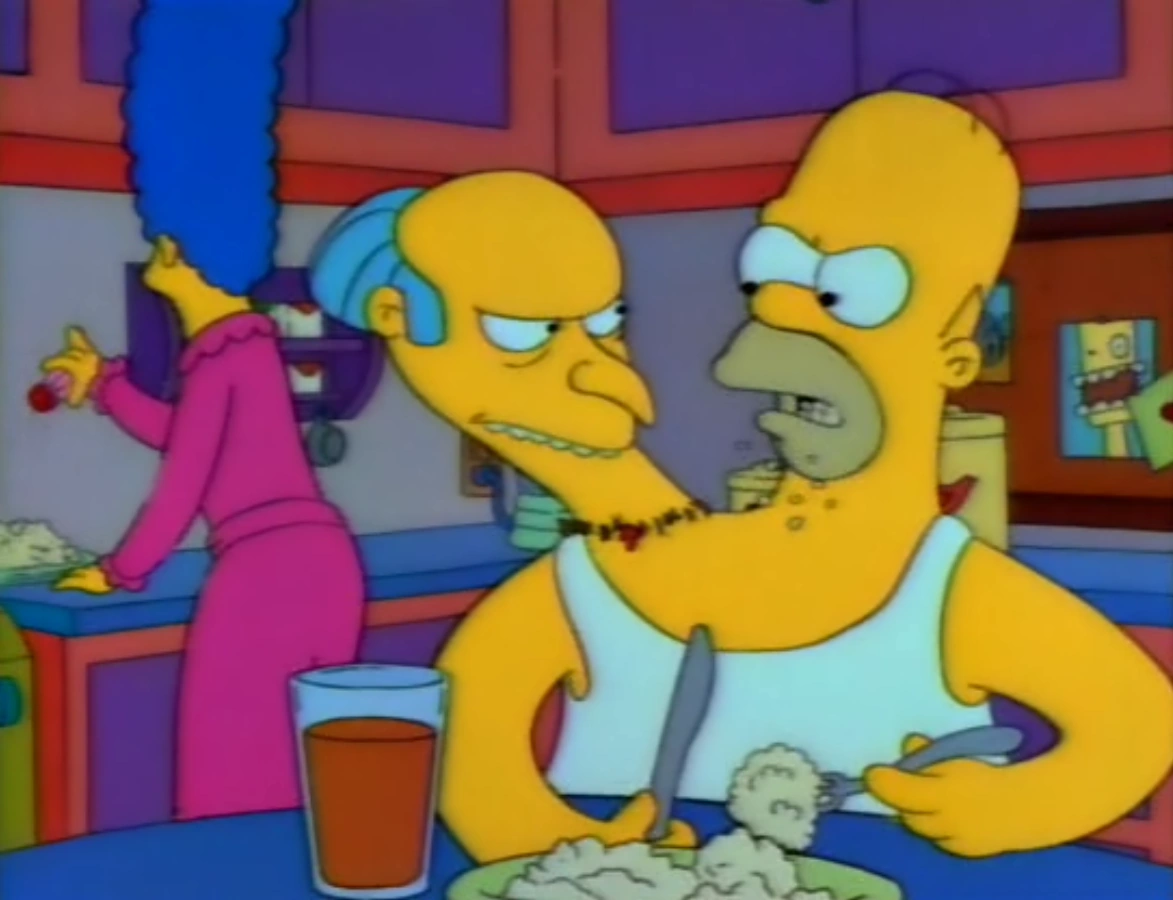
I get that some degree of spin is necessary; winners gonna gloat, and haters gonna hate. But these two narratives have nothing to do with the actual matter of public policy before us: the Olympic Games. They've been grafted onto the real financial and infrastructural issues at hand about as gracefully as Mr. Burns was sewn onto Homer. As the Olympics became more and more contentious in Boston this year, both sides were guilty of turning the debate into a process-based one. Rather than the question of whether it was good policy for Boston to host the Olympics, it became a referendum on the bidders themselves. And now that a decision has been made to stop seeking the Games, both sides continue to embarrass themselves by missing the point.

Let's start with the victors: those who sought to kill the Boston Olympics have touted the decision as a victory for their grassroots organization. It is conclusive proof, they say, that an inspired citizenry can successfully stand up to the big-moneyed special interests; we should all rejoice, they insist, that we stopped corporate elites from lining their pockets with that sweet Olympics cash from their rich friends. (A real sentence from the Boston Magazine article linked above: "The people of Boston, armed only with shoestring budgets and broken public records laws, stood up to the IOC, an organization as contemptible and endlessly wealthy as FIFA." Das Kapital is less rabble-rousing.) Poppycock. Elites run Boston, and they always have. The Olympics failed mostly because two key elites—Mayor Marty Walsh and Governor Charlie Baker—were not fully on board with the plan. And the cause for celebration isn't the fact alone that we defeated a "Goliath" of an enemy; it's that we avoided the headaches that places like London and Rio have suffered as they paid for and built their Olympic infrastructure.

The sore losers, meanwhile, have fallen back on an old chestnut: Boston is a provincial backwater that will never become the worldly city it deserves without the validation that the Olympic Games provide—and our snobbish, insular tendencies have now kept our city from real progress onto the world stage. It's a shameful logical fallacy that exploits one of Boston's deepest-held insecurities about itself: its inferiority complex. "Move in my direction, or else stay a small-time small town. WWNYD?" (What would New York do?) It's a false choice, and both halves are equally specious. First, of course, not all movement is progress. Boston 2024 proponents would have you believe the only path to improving the city—the only path to globalizing Boston—lies in hosting an extraordinarily expensive sporting event. But instead of investing in something frivolous like sports, we could design a master plan that spends sensibly on transportation, infrastructure, housing, education, and more. There are lots of ways we can reshape the city that aren't the Olympic way, and, in my opinion, it may well be smarter to do it differently. (This is why we need to have a conversation about the actual policy issues rather than get into this shouting match.) But instead the pro-Olympics crowd frames it so that they can yell "Provincialism!" if you don't go along with their plan.

Which takes me to the second specious half: accepting the premise that Boston is indeed an unworldly, small-time backwater. Boston of today may not be New York, but it has thrived as a center of the new knowledge-based economy, with world-class medical, educational, and technological institutions. We should always strive to improve our city, but at this rate, only a few course corrections are needed, not a massive reimagination of Boston's entire essence. The city should be proud of where it is. One particularly ignorant tweet complained about "NOlympics" in the same breath as Boston's supposed other stubborn refusals to modernize: "CasiNO" (Massachusetts will make millions of dollars in revenue after passing a 2011 law that will soon open three casinos and a slot parlor throughout the state), "Late night public transportatioNO" (responding to a longtime rider complaint, the MBTA began offering late-night bus and subway service over a year ago), and "Modern liquor/vice legislatioNO" (marijuana is decriminalized in Massachusetts, and there's a decent chance it gets fully legalized via a 2016 ballot measure). The region is not, by any definition of the word, "stagnant," as the New York Times suggested was a possibility.

So Boston 2024's argument ended up resting on the idea that Boston is a parochial hamlet, and pulling us away from that fate was the real issue, no matter the cost. And to No Boston Olympics, the real issue became stopping private interests from turning a profit on the backs of unwilling constituents. For each side, that was probably the easiest way to justify what they wanted. But it got to the point where these arguments were offered basically to the exclusion of the real real issues that made people support or oppose the Olympics in the first place: the best ways to build new infrastructure, the best ways to spend money, the best ways to market the city. As in so many other instances, the facts and informed debate took a backseat to building a neat little narrative that's less complicated for emotional minds to understand. In the end, Boston 2024 and No Boston Olympics were more alike than either would care to admit; they both tried to make this debate something it never should have been. Sadly, they succeeded.

Wednesday, November 19, 2014

In #MAgov, Blame Everybody—Springfield, Super PACs, the Wealthy—Except Martha Coakley

"I guess some mistakes you never stop paying for," says Roy Hobbs in The Natural—and, one imagines, Martha Coakley on Wednesday, November 5. The Democratic Coakley, as you surely know by now, had just lost her second high-profile election in five years in my home state of Massachusetts, supposedly the bluest state of them all. A figure of national ridicule for "blowing" (scare quotes definitely required on that one) Massachusetts's special US Senate election in 2010, "Martha Chokely" cemented her place as this century's biggest political loser when she fell, 48.5% to 46.6%, to Republican Charlie Baker in this year's open-seat race for Massachusetts governor.

Or so goes the narrative. And if there's one thing you should take away from following this blog, it's that narrative—in politics, baseball, or wherever—tends to obscure more factual, data-driven analysis. In this case, the nation's first impression of Coakley from 2010 refused to step aside for the 2014 truth: Coakley ran as strong a campaign as Massachusetts Democrats could ask for. From day one of the primary, she polled better against Baker than her even more flawed Democratic foes. Even as outsiders crowed about editorial boards' support for Baker, the endorsements they didn't read almost unanimously took pains to praise Coakley as an outstanding public servant and a solid candidate. And an 11th-hour survey of Massachusetts political insiders noted that Coakley successfully "reversed two key perceived flaws of her 2010 US Senate campaign: she worked impressively hard, and she built a superb field organization." A local perspective makes it abundantly clear: this loss wasn't Martha Coakley's fault.

Rather than assign blame, it's more productive to give credit: in this case, to Charlie Baker, who ran an incredibly impressive campaign—the strongest by a Republican in the Bay State in at least a decade. Baker, too, learned from his own 2010 defeat (in this case, a winnable gubernatorial race in a Republican wave year), retooling himself as "Charlie Baker 2.0": a more compassionate, more accessible, happier warrior than his aggressive 2010 self. The campaign also had a strong message ("Charlie Baker's no ideologue; he's a moderate retooler of a status quo that needs retooling") that passed the critical test of making fair-weather Democrats comfortable voting for, and publicly supporting, him. And, crucially, Baker had the means to publicize that message. Thanks to ample outside support from the Republican Governors Association (RGA), Baker and his allies far outaired Democrats on broadcast TV. The former CEO of Harvard Pilgrim Health Care and a fixture of Boston's financial elite, Baker also had little trouble lapping Coakley in fundraising.

The easiest way to slam Coakley is to say that it's really really hard for a Democrat to lose in deep-blue Massachusetts. But with these headwinds, and the rising Republican tide nationally, there was no way any Democrat was going to hit the comfortable performance benchmarks the party has grown accustomed to seeing in presidential years. Compared to the average top-of-the-ticket Democrat since 2008, Coakley ended up underperforming by 9.5 points statewide.

That's important context—but it's not the whole story. The dropoff Coakley experienced was hardly uniform across the state. She actually succeeded at holding onto usually Democratic votes in certain areas—yet her dropoff in other regions was especially steep. Apply a knowledge of the state's political geography to the town-by-town election results (a level of electoral detail I'm proud to say is available only in New England), and it becomes clear that the Republican takeover of the corner office was thanks to Baker's strengths, not Coakley's weaknesses.

The Rising Massachusettsan Electorate


There is a widespread assumption among the other 49 states that Massachusetts is a hand-holding liberal assimilated collective. It's not. Massachusetts is rife with the same internal divisions of socioeconomic status, geography, race, and, yes, party as exist in other states. And, like other states, it is changing. One of the defining struggles for power in Massachusetts in recent years has been between the clout of the white elite—who, in many differing forms, have dominated state politics for centuries—and the increasingly diverse, and growing, population of the state's cities. These newest Bay Staters don't much resemble the Beacon Hill gentry, racially or economically, gender-identity-wise or age-wise. They are immigrants, from Brazil, Cape Verde, Vietnam, Puerto Rico, or elsewhere; they are the next generation of the state's longstanding and long-suffering minority population; they are the city-dwelling urbanists, gays, hipsters, and yuppies who have settled in the state since Boston's renaissance as one of America's "cool" cities.

While the state's business elite was once frequently able to convince the overwhelmingly white electorates of the 1990s to elect like-minded, business-oriented Republican governors, today the "rising Massachusettsan electorate" has made that increasingly difficult. Minority voters specifically have gone from a drop in the bucket (5% of the 1998 electorate) to a critical voting bloc (21% in 2008) almost overnight. According to an excellent analysis by CommonWealth magazine, these new voters are making Massachusetts's cities, in particular, more reliable Democratic vote banks than ever before. Boston, as well as the equally important "Gateway Cities" that ring around it (Worcester, Lowell, Fall River, and more), have shifted left by double-digit margins in just the past decade or so, coinciding with the emergence of the new electorate.

The potential Republican path to victory has narrowed accordingly. Governors Weld, Cellucci, and Romney skated into the State House on some very thin ice (consistently, margins of three to five points), but Republicans fell right through when the Bay State's new faces started adding their voices beginning in 2006. Urban voters were instrumental in twice electing Deval Patrick the state's first African American governor; then, in 2012, Elizabeth Warren used a powerful GOTV operation in cities to topple Scott Brown and earn election to the US Senate. For Coakley and the Democrats, then, the 2014 campaign was all about proving that the GOP's window in Massachusetts had closed completely—that the urban coalition was the permanent new kingmaker of state politics.

Baker, of course, had other ideas, and much ink was spilled about his unusual strategy to reverse Republican losses in cities: he spent most of his time campaigning in and talking about them. For much of the fall, Coakley and Baker went head to head for urban voters; everyone, including Coakley herself, knew that the Democrat could not win without a strong performance in the cities. It would certainly be reasonable to declare her campaign a failure if it had fallen short of this goal—and, when Baker won statewide by cutting into her metropolitan margins of victory, many outlets and observers did just that. But this is the wrong way to look at it. As mentioned above, any discussion of Coakley's regional or factional dropoff must be qualified with the 9.5 points better that Baker did overall thanks to his built-in advantages. Accounting for this, Coakley actually did what she needed to do in cities.

For this post, I calculated the average Democratic performance in all 351 cities and towns in Massachusetts in presidential, gubernatorial, and senatorial elections since 2008 (the era since the awakening of the "Obama electorate"). Based on how Democratic or Republican each city is relative to the rest of the state, we can easily calculate how well Coakley "should" have performed given her 9.5-point drop from average statewide. As it turns out, Baker's urban strategy did not have much of an effect beyond his overall statewide momentum. In fact, Coakley overperformed her expected percentages in most of the state's largest and most diverse municipalities:


In Boston and Worcester, the state's two biggest cities, Baker and Coakley essentially fought to a draw, as Coakley's actual performance was quite close to 9.5 points below the Democratic average. But in liberal strongholds like Cambridge and Somerville, as well as Gateway Cities like majority-Hispanic Lawrence, heavily African American Brockton, and Asian enclaves like Lowell or Quincy, Coakley did not bleed as many votes. In fact, Coakley improved upon her own 2010 performance in 10 of Massachusetts's 11 least white communities.

So despite conventional wisdom, in most cities, Coakley hit the win numbers she would have needed to eke out a narrow victory—if the rest of the state had gone along. By winning the urban vote, Coakley held up her end of the bargain. Who can Massachusetts Democrats point the finger at who didn't?

Damn Yankees


On October 6, 2014, Martha Coakley released a Spanish-language TV ad emphasizing her outreach to the Hispanic community and showing her talking to Hispanic business owners. The same day, Charlie Baker was hobnobbing with businessmen of his own: at a fundraising dinner at Boston's L'Espalier, the fanciest restaurant in the city. From just 40 Boston CEOs, including Hill Holliday's Jack Connors and Suffolk Construction's John Fish, Baker raised $200,000.

If the Coakley campaign's goal was to assert the superiority of a new generation of voters, the Baker campaign's goal was to show that the state establishment still held the leverage to determine an election. And the Massachusetts elite loved Baker, who seemed to be custom-made for them at Brooks Brothers. A successful businessman, generous political donor, and policy-oriented health-care executive, he didn't just fit their profile; he was one of them. Baker's championing of welfare reform and lower taxes was music to their ears, and there was no pro-life or anti-gay rhetoric to scare off these usually Democratic powerbrokers. In 2010, when Baker challenged an incumbent governor, this cautious crowd wasn't quite ready to take the plunge. But in 2014, against a pro-worker attorney general whom many had soured on after 2010, the Massachusetts high society flocked to Baker. It was a flood of support epitomized by Connors and Fish; by the Boston Globe editorial board; by party-line-crossing Democratic officials who endorsed him. But all that symbolic support can't be said to matter unless raw votes followed suit.

Even if the Beacon Hill elite have lost their influence on the urban vote, there is still an identifiable voting bloc over which they retain the ultimate sway: their own. Massachusetts is home to the fourth-largest concentration of so-called "Super Zips"—America's top 5% most educated and richest communities—in the country. In presidential elections, these wealthy Boston suburbs usually vote Democratic, turned off by the national Republican agenda—but they are where Yankee Republicans get elected governor of Massachusetts.

For all the talk about Coakley ceding ground to Baker in cities, he actually won the same well-worn way that Weld, Cellucci, and Romney dispatched their own Democratic opponents: he did extremely well among the state's upper crust. According to WBUR tracking polls throughout September and October, wealthy voters (those making over $150,000 a year) broke sharply for Baker in the race's closing weeks. A full fifth of the projected electorate, they preferred Baker 52% to 35% in the final poll.

This translated to Baker doing even better than we would have expected him to in Super Zips, based on the same historical Democratic averages as above. Search the town-by-town election results for a geographic region where Coakley underperformed by even more than her 9.5-point drop statewide, and you'll quickly notice a cluster of Baker strength in the towns immediately west of Boston. Not coincidentally, these commuter suburbs are the homes of Massachusetts's intellectual, cultural, and economic elite. In the western suburbs with the highest incomes in the state (median household income exceeds $100,000 in almost all of the localities listed below), there is a clear pattern of Coakley underperformance due to Baker's strong connection with these voters:


The list's biggest offenders included the three Ws. Weston, one of the richest towns in the United States and home to Red Sox legends David Ortiz and Jerry Remy, embraced Baker to the tune of 5.3 fewer points for Coakley than expected. Wellesley, location of the eponymous college, shunned Coakley by an extra 4.5 points. Even relatively liberal Wayland, hometown of Jonathan Papelbon as well as your humble blogger, scored 3.8 points below expected for Coakley. Overall, a WBUR analysis found that Coakley ran behind her 2010 self in every normally Democratic community with a median household income over $90,000. (Tangentially, this may also explain why Coakley dropped off more in Boston than in other cities; unlike the Gateway Cities, Boston has a handful of extremely wealthy neighborhoods, such as the Back Bay and West Roxbury, which defected heavily to Baker in 2014.)

Democrats were betting that their new urban base meant this wouldn't matter. But Baker's win showed that, in a head-to-head matchup, rich suburbs could still hold their own. More than that, in fact: as Dave Wasserman observed at FiveThirtyEight months before the election, Super Zips, where they exist, remain a dominant electoral force. Wasserman deconstructed the results of Virginia's own gubernatorial election in 2013 and came to an instructive conclusion: despite Democrats' boasts that higher minority turnout had won Terry McAuliffe the executive mansion there, the real difference-makers were the rich Washington suburbs, which saw McAuliffe as one of them and disdained his Tea Party opponent. In the end, Super Zips decided both Virginia and Massachusetts—for different parties, but for the same type of candidate.

Massachusetts Democrats could have learned from this, had they looked past Virginia's final result and seen that minority voters alone wouldn't have elected McAuliffe. Democrats in either state couldn't win without minorities and city-dwellers, to be sure, but in low-turnout elections like 2014, the elite are still disproportionately decisive. This could change in 2016 and later as the Massachusetts electorate grows even more diverse. But for 2014, Coakley lost the same way Democrats have been losing Massachusetts for decades. For now, in the Bay State's great power struggle between cities and suburbs, the suburbs lived to fight another day.

That was good news for Baker this year, and it will be good news for him in 2018 and for future Republican candidates in Massachusetts. It's undeniable that Baker couldn't have won without his unusually strong support in the hometowns of the privileged, and it was his own strengths as a candidate—not anything Martha Coakley did or didn't do—that he has to thank for it. However—and yes, there's even more to this saga—in my opinion, the Boston suburbs weren't where Baker truly clinched his win. With one win apiece (urban areas for Coakley, suburbs for Baker) in the Boston area, an often-underappreciated part of the state provided the rubber match.

Last Exit to Springfield


There was one last part of Massachusetts where Baker did exceptionally well—where Coakley, had she met expectations there, could have still scraped out a statewide win despite everything else: Western Massachusetts. The denizens of Western Mass will thank you not to forget about them the next time you equate Massachusetts with metro Boston; here, the TV is broadcast from Springfield or Albany, the bluest towns are the smallest towns, and you might even be able to dig up a Yankees fan or two. Given the region's sensitivity to its place in the state, campaigns absolutely must give it the attention it deserves, and both Coakley and Baker spent plenty of time out here in 2014.

Berkshire and Hampshire Counties are strong Democratic strongholds, and Coakley won them with minimal dropoff in 2014. But the real prize in Western Mass is Hampden County, home of Springfield, the state's third-largest city. Greater Springfield may be the one place that Baker's urban strategy did pay off, as he embarrassed Coakley with his performance in this metro area. Even factoring in Coakley's expected 9.5-point drop, the Democrat underperformed in Hampden County's nine biggest municipalities even worse than she did in most of the western Boston suburbs:


I'm not as familiar with Western Mass as I am with the areas around Boston, so I can't quite account for this. However, I'd be remiss if I ignored the potential impact of the hot topic in Springfield from 2014: casino gambling. A city in need of revitalization, Springfield is banking on a proposed downtown casino to create jobs and pump money into the regional economy. However, a ballot measure to ban casinos in Massachusetts was on the 2014 ballot, which could have affected turnout in Hampden County—although not necessarily to any one candidate's benefit. True, Baker had promised to still push the Springfield casino even if gambling was outlawed in the state, but so did Coakley. Other explanations for the discrepancy could be that Baker just had a particularly strong field effort around Springfield, or perhaps his television-advertising advantage was more pronounced here.

Regardless, something inspired Springfield and all of its major suburbs to tack even more Republican than the state as a whole this year. Although I was able to find ready explanations for all the variations from average in the rest of the state, this one truly surprised me. Yet it is perhaps the most notable variation, in terms of votes it was worth. For all the Boston-centric chatter about Eastern Massachusetts cities and the Boston suburbs dueling to pick the next governor, there's some poetic justice to the fact that Western Massachusetts was probably the clincher in 2014.

~~~~~

Something Martha Coakley's detractors ignore is how close she came to becoming Massachusetts's next governor. Eight of the final nine polls of the race spelled out, unambiguously, how Baker was the clear favorite: leads of six, seven, even nine points. Unlike 2010, when complaints of a Coakley "collapse" were better founded, the Democrat actually did better than expected: from a final polling average that showed Baker up by almost four points, she cut his eventual winning margin to less than two. That's not something an incompetent campaign does.

Sure, Coakley could've done better in cities—but she did well enough. Coakley could've done better around Springfield—but we don't know what in the world went wrong there. And... well, no, she probably couldn't have done better in Super Zips. Baker simply had too much of a built-in advantage. She couldn't stop donors from giving huge checks to Baker. She couldn't prevent the RGA from making its huge ad buys. She couldn't take away the free will of Democratic VIPs to throw their support to Baker. None of these things were her fault.

Instead, the "blame" for a Coakley loss—if you even want to frame it that way—probably lies with the people she needed in her corner turning their backs on her. One of Coakley's biggest problems this year was raising money, but many of Democrats' usual high rollers had decided instead to give their money to Baker. To many Beacon Hill lobbyists and Boston businessmen, Coakley was already damaged goods. The same was true of the DC establishment, whose super PACs did not give Coakley nearly as much air cover as the RGA gave Baker. Coakley will always be viewed inside the Beltway as the person who did what Washington considers impossible: lose in Massachusetts as a Democrat. And finally, there was a subset of Massachusetts voters who never came to fully trust Coakley after 2010: for lack of a better categorization, Steve Grossman primary voters. The Democrats who backed Coakley's main rival in the gubernatorial primary mostly did so not because they loved Grossman, but because their motto was "anybody but Coakley." It's a baffling motto for any Democrat to have, given Coakley's sterling record and liberal credentials; it can only be derived from disgust at the person who once thought Curt Schilling was a Yankees fan. That and other missteps in late 2009 and early 2010 were bad, but they are also ancient history. In 2014, the only misstep you could say Coakley made was not earning enough forgiveness, not eliciting enough sympathy, not inspiring enough support.

Maybe you could say that about any candidate. In fact, they do. It's the default for most campaign autopsies. But Martha Coakley doesn't get that benefit of the doubt, solely because of her history. Hopefully, the data, and the anecdotes, can exonerate her this time. No, Martha Coakley didn't lose because she's such a terrible candidate. She lost because she never stopped paying for five-year-old mistakes.

Monday, September 29, 2014

The Real Battle in #MAgov: WBUR vs. the Boston Globe

Look at a graph of Massachusetts governor polls this year and you'd think it's been an extremely volatile race: the last five polls have gone Baker +2, Coakley +10, a tie, Coakley +3, and Coakley +9. Problem is, you'd be wrong. The horse race has actually been remarkably stable; it's the campaign's two premier pollers that have diverged.

Almost all of the polls that have shown a statistically tied race have come from SocialSphere and been sponsored by the Boston Globe. SocialSphere conducts a weekly tracking poll of the race, and its last three results have been Baker +2, Coakley +3, and Baker +1. On the other hand, the MassINC Polling Group runs a weekly tracking poll of its own, sponsored by WBUR, Boston's public-radio station. MassINC's results have consistently given Democratic Attorney General Martha Coakley a solid lead: Coakley +10, Coakley +9, Coakley +5, and Coakley +9 in the same time span as the Globe polls.

So even though the polling average suggests a "Leans Democratic" race, this contest is probably either "Likely Democratic" or an outright "Tossup." But which pollster is right? Let's poke around into each poll to see where their discrepancies might originate. The most recent Globe/SocialSphere poll is here with crosstabs here. The latest WBUR/MassINC polling memo is here, and crosstabs are here.

The differences aren't immediately obvious to find. Both polls use registration-based sampling and called both landlines and cell phones. Both firms conduct live telephone interviews, and the sample sizes were not significantly different (502 likely voters for MassINC, 400 likely voters for SocialSphere). The similar methodologies produced similar samples, too. The MassINC poll breaks down as 36% Democrats, 12% Republicans, and 52% unenrolled. The SocialSphere poll's partisanship is 35% Democratic, 13% Republican, and 52% unenrolled. MassINC's sample was 84% white, and SocialSphere's was 85%.

There were some slight differences. The SocialSphere sample was 55% female, while MassINC's was 52%. And although the age categories did not line up perfectly between the two polls, it looks like SocialSphere surveyed a much older electorate. For MassINC, 38% of respondents were age 44 or younger vs. 29% for SocialSphere. Half of SocialSphere's sample was 55+, while just 29% of MassINC's was 60+. But the biggest difference of all was in level of education. The electorate projected by SocialSphere was 30% postgraduate degrees, while only 16% had some college, but no degree. For MassINC, only 21% had an advanced degree, and a full 29% said the highest education they had reached was some college but no degree.

However, none of these explains the 12-point discrepancy. SocialSphere's bigger pool of female voters should have helped Coakley do better in the Globe poll than the WBUR poll, not worse. (More to blame is the fact that Coakley led women by a whopping 25 points according to MassINC and "just" 15 points according to SocialSphere.) And MassINC found that the candidates were more or less tied among "some college, no degree" voters but that Coakley was way ahead with holders of postgraduate degrees (the SocialSphere poll was too small to provide crosstabs for each specific education category), which, again, should have underestimated her support. Finally, although both polls agreed that Martha Coakley did best with young voters (52% to 28% among 18- to 29-year-olds per MassINC; 57% to 19% among 18- to 34-year-olds per SocialSphere), Coakley won every age group in the MassINC poll, so her lead wasn't just due to millennials. It was more that the polls wildly disagreed on how older voters felt. SocialSphere gave Baker a whopping 51%-to-29% lead among voters ages 55–64.

As you can probably tell by now, the real disagreement between the polls has to do not with their sampling, but with how each candidate is performing with different segments of the electorate—the most confounding and unresolvable way to disagree. Is Baker winning independents 45% to 23%, as SocialSphere says? Or is it basically a tie game, 43% to 38%, as MassINC says? How do women voters genuinely feel—massively pro-Coakley, or does Baker still have a fighting chance with them? And are voters making $150,000 or more really spurning the millionaire Baker to vote for Coakley, 46%–38% (MassINC), or is Baker the one up by 47%–38% among those making $100,000 or more a year (SocialSphere)? We won't truly know until Election Day.

Normally I would defer to the better pollster, but neither firm in this case has really given us a reason to doubt it. MassINC is an extremely reputable firm up in the Bay State, with a long record of excellence and a solid B rating from FiveThirtyEight's newly released Pollster Ratings. SocialSphere, meanwhile, is a newish firm, so it doesn't have a pre-2014 track record to base any judgments off (indeed, FiveThirtyEight doesn't even give it a rating). And if you're looking to outside pollsters to break the tie, you're out of luck; since the beginning of September, two national firms polled the state, and one agreed with MassINC and one agreed with SocialSphere. When it comes to how Massachusetts's key constituencies are feeling in this surprisingly close race, the best any of us non-professionals can do right now is guess.

UPDATE: Maybe we don't have to wait until Election Day after all. A spate of polls Monday all agreed with the Globe results, and then WBUR's tracking poll released on October 1 also moved in line with the SocialSphere numbers.


Wednesday, September 3, 2014

Primary Endorsements Show Where Massachusetts Dems Are Drawing Their Battle Lines

As any member of an organized political party will tell you, they're really not all that organized. My home state of Massachusetts is one of several places where one-party rule has caused the political divides that really matter to be intra-party ones. (Kansas is another example.) When outsiders make cracks about how liberal and/or monolithic Massachusetts is, they're showing how little they know about the Democratic Party's extreme factionalism there. In actuality, the party's seemingly giant legislative majorities (36–4 in the State Senate, 125–29 in the State House) are more the result of British-style coalition building between several smaller parties, sometimes with very different identities and policies but yet all, for reasons practical to historical to programmatic, considering themselves Democrats.

Hoping to pen a more ambitious analysis of these subparties in my home state, I canvassed every endorsement issued in the Massachusetts Democratic primary this cycle for the four contested statewide races: governor, lieutenant governor, attorney general, and treasurer. (In a state with one-party rule, after all, the primary dictates which clan sits on the throne for the November coronation.) Unfortunately, the data ended up being too thin to expose the detailed fault lines I wanted to map out, so my original idea for this post fell by the wayside. However, there's still a place for the data that do exist, so I'm leaving them here for Massachusetts political junkies to play with.

Any Democratic politician or organization that endorsed this cycle is listed in this Google doc—also embedded at the bottom of this post. You can see whom they endorsed in each of the four major races. Most only endorsed in one or maybe two races (that's why the data was too thin), but if they endorsed in three or four, their full voting slate is laid bare in that spreadsheet.

Just for fun, we can cross-analyze how much endorsements line up with each other. Do all Tom Conroy for treasurer supporters also support Warren Tolman for attorney general? (Yes, it turns out, but not all Tolman supporters support Conroy.) This gives us a tease of some of the aforementioned Massachusetts Democratic factions—witness, for instance, how endorsements for progressives Don Berwick and Maura Healey line up pretty well—but mostly it's just a confusing mess.

In the chart below, the rows represent the universe of people we are considering to calculate the percentages (i.e., the denominator), and the columns represent the characteristic being measured within that universe (i.e., the numerator). Read the chart by asking, "What percentage of [row] are [column]?" So, for instance, you can find what percentage of Steve Grossman endorsers also endorsed Steve Kerrigan by going to the Grossman row and the Kerrigan column. Percentages are out of the people who endorsed in both the former and latter races being considered, not just in the former race; as a result, percentages all add to 100% and there is no cell for "[Candidate] endorsers... ... supporting no one." Endorsements of withdrawn candidates, like Joe Avellone, don't count for chart purposes (even though they're listed in the spreadsheet for comprehensiveness).

In the chart, read down a column to see the percentage support that a given candidate got among universes of different endorsers (and compare it to the share of the race's total endorsements received by that candidate, displayed in the bottom row); read through a row to see how endorsers of a given candidate split their support in the other three races (useful if you're undecided in one of the races and want elite support to guide your vote).

Spot any interesting patterns? Leave them in the comments!


Friday, October 18, 2013

Graduation Day for the Emerson College Polling Society

In Tuesday's Democratic primary in MA-05, more than just State Senator Katherine Clark emerged with a win. It was also a big night for nascent pollster the Emerson College Polling Society (ECPS). The outfit was the only public pollster to dip its toe into the congressional special election, and its October 2–8 poll correctly predicted Clark's 10-point margin of victory (albeit over the wrong runner-up). The firm has also polled the closely contested Virginia governor's race and June's Massachusetts Senate special.

But while these and other of ECPS's polls have been remarked and reported on, there has also been a fair amount of skepticism toward the pollster in the political sphere. This famously insular community was never going to simply welcome a newcomer like ECPS with open arms, of course; in a town like DC, you get credibility only by earning it. And rightfully so—it's good for people to rigorously question and test unknown commodities, especially when they're playing with live ammo to the degree that pollsters are.

But with ECPS, I question what people are questioning. The doubt that seems to surround ECPS in political circles is not a natural, healthy skepticism, but rather a dismaying bias against it for its unique status as a student organization. I've had debates with other political analysts about ECPS in which my peers were wary of believing its polls simply because they were conducted by students. Then, in the wake of the MA-05 primary, I read this well-meaning yet offensive post on the blog Blue Mass Group:
"This outfit, which appears to be a student-run organization at Emerson College, seems to be the only independent organization to have polled the race (more on that in a sec). I didn’t post on the poll they released last Friday because it’s hard to tell if they’re just a student club having fun, or if they are running real polls. … I still wish I knew more about how they’re set up … like, are any grown-ups involved with them? :)"
To be clear: I don't believe we should accept every new outlet that walks up and calls itself a pollster. But a student group is every bit as capable of producing high-quality, scientifically rigorous work as a professional firm, and it's insulting to say otherwise. ECPS has proven as much with the accuracy of their polls to date, exactly nailing the final margin of the Markey/Gomez Senate election as well as the this week's congressional primary. In the case of MA-05, ECPS especially impressed because of how notoriously difficult it is to poll special House elections (they deserve credit for being the only public pollster to even try).

Just as relevantly, their conduction by students does not imply a sloppier or less precise methodology to ECPS's polls. Even in this day and age, there remains a notion that party-hardy college students can't take things seriously or be responsible members of society. But like the ubiquitous columns that bemoan the laziness and entitlement of the Millennial generation, anyone trafficking in false and ignorant assumptions about students' capabilities is guaranteed to have no understanding or first-hand knowledge of the subject. This is not just a bunch of students playing around with phones and numbers. Just the opposite. Students don't often create polling societies, or stick their necks out into the adult world like this, every day. I can tell you from experience that the students who undertake something like the ECPS do so because they are uncommonly serious about learning—and about their craft. In fact, student organizations founded to compete with the big boys have a thirst to be taken seriously that is unmatched by anyone else.

A slightly more valid complaint would be that the people running ECPS don't even have college degrees—even though the same is true of countless accomplished individuals. But it is also an arbitrary line to draw, since a college graduate doesn't go from uneducated to educated the minute he receives his diploma. In fact, ECPS workers are totally immersed in what is probably the best possible influence on a data cruncher: academia. The pollsters of ECPS may not have that degree in hand yet, but they have more immediacy to the science of polling because they are taking classes and learning about it in the moment. (In fact, in my experience, student organizations are often book-smarter and more rigorous in their standards than professional firms because of this.) These classes, of course, are taught by universally renowned and credentialed experts in the fields of polling, statistics, political science, and more. Any gaps students have in their still-developing knowledge (important caveat: even as a 50-year-old, if your knowledge has stopped developing, you're doing it wrong) are more than made up for by the fact that those gaps can be filled by these unimpeachable authorities. Every student group I've ever heard of has had a faculty adviser, and a quick Google search reveals ECPS is no different. This is not "just a student club having fun." It's a responsible collection of students and their mentors who feel their skills are ready to be tested.

Not every student group should be taken seriously, just like not every company run by "adults" should be taken seriously. But college students founded, and in many cases still run, many businesses that are widely accepted and trusted. Let's Go, the internationally known travel guide on six continents, has been since its founding 53 years ago an entirely student-run organization—one I am proud to have written, edited, and overseen for. The social-media analytics firm Syndio Social started as a student group at Northwestern but now is an industry leader with huge corporate clients like Procter and Gamble. The Statler Hotel, the only luxury hotel in Ithaca, NY, is run by students at Cornell's hospitality school. Countless radio stations, including several that dominate their otherwise-underserved market, are run by students. And now, the Emerson College Polling Society simply seeks to join in the tradition of serious student contributions to the "adult" business world.

At 18, 20, even 22 years old, college students not only have "grown-ups involved with them"; they are grown-ups. Election law treats them this way; the criminal-justice system treats them this way; we should treat them that way. ECPS should be held to the same standards and subjected to the same scrutiny as any other pollster.

I'm no expert on polling, but to me ECPS passes this test. It has a detailed website, including a methodology page disclosing its vendors and laying out a polling procedure that, as far as I know, is accepted and standard in the industry. It releases the full scripts, raw counts, and crosstabs of its polls. If someone with more knowledge of polling wants or needs to see more to be convinced, cool—ask ECPS to show you more and I'm sure they'd oblige. But if what ECPS currently provides isn't enough, that further inquiry should be the default reaction—not a lazy dismissal of its chances as a serious firm without giving it a chance. If a new professional polling company emerged with the same level of public disclosure as ECPS, it would probably get the benefit of the doubt—and if not, it would be administered a proper and fair test to prove its worth. The industry's perception of ECPS should be based off the same.

Thursday, September 19, 2013

Tracking the Polls: Boston Mayor

Primary day in the Boston mayoral election is next Tuesday, September 24, and the field is—to put it mildly—fractured. No fewer than 12 candidates are seeking the rarely available job, and Bostonians are splitting their support almost evenly. This has made polling the race extremely difficult, with few candidates even breaking into double digits and the frontrunner always within the margin of error. Still, the polling is useful to look at in aggregate—so aggregate the polls this post shall, since I don't believe there's a website that currently provides all the race's surveys at a glance. The following list of public polls for Boston mayor (note: these are the "with-leaners" versions of the polls) will be updated through Tuesday:

Poll Dates Sample MoE Arroyo Barros Clemons Conley Connolly Consalvo Golar Richie Ross Walczak Walsh Wyatt Yancey
Suffolk/Herald 7/10–7/15 600 4% 4% 1% 1% 9% 12% 8% 5% 5% 2% 11% 1% 3%
Sage Systems 8/21–8/22 821 2.7% 6% 3% N/A 9% 12% 7% 7% 6% 3% 11% N/A N/A
UNH/Globe 9/5–9/12 411 4.8% 6% 6% 2% 10% 15% 6% 10% 5% 4% 10% 0% 3%
MassINC/WBUR 9/14–9/16 487 4.4% 8% 3% 0% 8% 15% 5% 10% 6% 4% 12% 0% 1%
Suffolk/Herald 9/12–9/17 600 4% 6% 3% 1% 12% 16% 8% 10% 5% 6% 12% 0% 1%


For not a lot of data, this paints a reasonably clear picture of the race. City Councilor John Connolly is almost certainly in the best position, coming in first in all five polls. The battle for the second runoff slot behind him is tight, though; State Representative Marty Walsh and Suffolk County District Attorney Dan Conley are strong contenders, while Charlotte Golar Richie (the race's only woman) has clear momentum. Of course, the big picture remains that the results are unpredictable and that no candidate is more than a couple points out. Although the aforementioned four have to be considered the race's "frontrunners" right now (such as they are), four other candidates (Felix Arroyo, John Barros, Rob Consalvo, and Mike Ross) have been within the margin of error for the second slot in at least one poll. It should be a wild ride leading up to Tuesday.

Tuesday, April 23, 2013

Where the Polls Stand in Massachusetts

Doing some research this week, I noticed that the usual suspects—FiveThirtyEight, RealClearPolitics, etc.—weren't aggregating polls for the upcoming special Senate election in Massachusetts. Doing the research myself wasn't hard (there have been only a handful of polls), but I also don't want anyone else to duplicate the work. Therefore, without further ado...

Here are the results of all polls I could find of the Democratic primary for the special election for John Kerry's Senate seat, to be held on Tuesday, April 30:

Poll Dates Markey Lynch Undecided
PPP 1/29–1/30 52% 19% 29%
MassInc/WBUR 2/11–2/13 38% 31% 26%
PPP/LCV 2/13–2/14 43% 28% 29%
Garin-Hart-Yang/LCV 2/26–2/27 42% 28% 30%
UML/Boston Herald 3/2–3/5 50% 20.5% 23%
MassInc/WBUR 3/19–3/21 35% 24% 41%
PPP/LCV 3/26–3/27 49% 32% 19%
WNE/MassLive 4/11–4/18 44% 34% 21%
Lynch for Senate 4/20–4/21 44.5% 38.9% 16.5%
PPP/LCV 4/23–4/25 50% 36% 14%

Tuesday, April 16, 2013

A Few Words on Boston

On March 22, at 5:45pm, I had dinner with my mother at Max Brenner at 745 Boylston Street in Boston. Twenty-four days later, the sidewalk out in front of the restaurant would go up in a ball of fire. To get there, I climbed out of the now-closed Copley T station and walked down the north side of Boylston Street. Not one to make eye contact on the street, I stared at those square gray tiles underfoot now immortalized in red. Before sitting down to dinner, I crossed the street to meet up briefly with my girlfriend and her sister in front of the Pru. Their arms overflowed with shopping bags as we chatted in the same spot where innocent eyes would, 24 days later, be witness to this.

Yesterday, this was what affected me the most. I'm sad for the victims, of course. But no more than I was for Newtown, or Oklahoma City, or Iraq, or Israel. It turns out there's something else at play when your turf is the one being attacked. Instead of being sad, I find that my dominant emotion is anger. I am pissed, furious that someone would think to do this to my home, enraged that they could succeed in altering it.

No people I knew were harmed yesterday, but a place I knew was. I don't mean to say the two are equivalent; I know I'm lucky that this is the closest a tragedy has ever hit for me. But, at 25 years together, Boston has been my oldest and dearest friend. We went to school together; we went through puberty together. We shopped at the same stores (Jordan Marsh) and liked the same food (Santarpio's). Neither one of us really liked staying up past 1am, except when the Red Sox were on the West Coast.

So when Boston was attacked, I felt attacked, even though I was 500 miles away at the time. While I didn't lose a friend like too many others did, mine was defiled. To those who love Boston, the feeling was of a violation of something that was ours, shared among millions but strictly off limits to those who would do it harm. It was the theft of the Make Way for Ducklings statue, the Gardner Museum heist, and the Harvard dorm shooting combined—then amplified by about a thousand. It was a desecration of all the psychic imprints we've left behind on those blood-stained sidewalks.

Places don't die. They do something much worse. They mutate. I'll never be able to walk down Boylston Street again without stepping over spots where people died. Patriots' Day in Boston will live on, and I have no doubt it will very soon return to a festive and joyous occasion. But people on their way to watch the marathon will always remember this attack in the back of their minds. I'm not talking about some nebulous sense of security being gone; I personally don't place a lot of stock in that. Just the knowledge that it happened, and that it's now as inseparable a part of Patriots' Day as reenactments and a morning baseball game. I hate that we have to face that truth now. I hate the people who introduced terror to this joy.

Boston is a city of history—history of 200 years ago and the personal history of two decades. That history is imbued into every cobblestone, brownstone, and corner. Now an act of evil is one of them, on a holiday when only happy memories have ever been deposited. That's it, isn't it? They attacked our memories. Memories, which we are supposed to be able to keep preserved forever, which are supposed to be untakeable from us. Memories of happy marathons past, of every sunny day on that stretch of Boylston Street, are tainted. That's why it feels different to Bostonians. Tragedies ruin victims' futures. Now I see that they also ruin ordinary people's pasts.

On April 1, I moved away from Boston for good. My memories were casualties of the Boston Marathon bombings, but those memories are all I have now. That's probably why, when I heard initial reports of an explosion, my first instinct was to get on a plane and head back home. Not only did my city need me, but I needed it—to leave me with more than the pieces of my broken memories. To give me the embrace of home, and all that was still the same about it.

Sunday, April 22, 2012

Occupy Fenway? Red Sox Nation as a Protest Movement

Here's a fact that would have been unfathomable in the days before social media: after 14 games, Boston is calling for Red Sox manager Bobby Valentine's dismissal. While this would be a foolish overreaction, it's born of a very real problem: they may cost $146 million, but the 4-10 Red Sox aren't playing like it.

The team's struggles famously stretch back to last year, when the Bloody Hose went 7-20 in September and blew a massive Wild Card lead. After the season, Red Sox Nation reacted with unprecedented ferocity, leading to the departure of foundational leaders Terry Francona and Theo Epstein—victims of one of the most unforgiving PR firestorms in memory.

Obviously, when a team is floundering, it attracts its fair share of vitriol. The 2012 Red Sox have picked up just where the 2011 version left off—earlier this week, their lightning rod of a manager was perceived to have slandered one of his players, prompting rebukes and a mini-mutiny from the rest of the clubhouse. There are already columns saying he has lost control of his players and that he's not long for the city of Boston.

But I believe there is a another dimension to the bad press that isn't so ordinary, one that can be teased out from some of the most extreme excoriations of last year's Red Sox. That team struck a chord with Bostonians, and not a good one either. It's a chord that was already sensitive from another event that shared the headlines with the Sox' epic collapse that September and October: Occupy Wall Street.

You see, the 2011 Red Sox were attacked not just for poor performance on the field, nor even for poor managerial decisions. They were attacked for being lazy, entitled, and—most interestingly—rich.

The first rumblings can be seen in a story by Boston Globe columnist Dan Shaughnessy from September 23 arguing that the Red Sox were "not worthy" of a playoff spot. "Really, how do you root for these guys anymore? They have the third-highest payroll in baseball," Shaughnessy wrote, rather starkly connecting the two. In a line straight out of the French Revolution, he concluded, "These Sox have simply been too fat and too happy too long."

Then came the post-season post mortem, in which it was infamously revealed that the Red Sox' imploding starting pitchers, including $82.5 million bust John Lackey, were eating chicken and drinking beer in the clubhouse instead of hitting the gym to correct the fact that they were out of shape. It's the baseball equivalent of AIG throwing a lavish party two weeks after receiving a government bailout—except instead of revelry funded by taxpayer money, it was sloth funded (indirectly) by the ticket purchases of hardworking Bostonians. (Without that record sellout streak, the Red Sox wouldn't have one of the game's highest payrolls.) In both cases, the recipients of those public monies acted as if they were entitled to the money and/or the attendant indulgence, despite the fact that they used the cash for the opposite purpose for which it was intended (i.e., to do their jobs). Perhaps it would have been different if they had been doing these things while also performing at an acceptable level, but between AIG's role in the financial meltdown and the Red Sox' awful play, neither was showing why they deserved the massive salaries they were making. It is that kind of perceived upper-class greed that Occupy Wall Street was formed in response to.

The article also revealed that the unhappy Red Sox were treated to a night on owner John Henry's luxury yacht as a conciliatory gesture—reminding fans of his own privileged position. In the immediate aftermath of the September collapse, much of the rage in Boston actually centered on Henry, Larry Lucchino, et al. for this very reason. As the organization they had built appeared to crumble and, eventually, implode, Henry was cast as impotent and aloof. Accusations that his attention had turned to his "shiny new toy"—the Liverpool soccer club he recently acquired—at the expense of the Red Sox persist to this day. This, too, is not so different from, say, a noble-purposed investment-banking firm becoming more and more obsessed with profit and forsaking the customers who trusted it.

I believe that the rage against the Red Sox last October—and, perhaps, to some extent this April—was so very tinged with populism because it came from the same place within society as more traditional, "legitimate" social movements. I don't think you would have seen the same timbre of reaction if the economy hadn't been in the tank, or if income inequality hadn't become the issue of the moment. But they were, and Occupy Wall Street was hardly the only protest movement to reflect it. While it sits at the opposite end of the ideological spectrum, the Tea Party has similar roots: dissatisfaction, anti-elitism, disillusionment, and even desperation—the feeling that the only recourse left open to effect change is getting up and shouting. History is filled with other examples from similarly desperate times: the rise of the pro-silver Populist Party in the 1890s, the Depression-era Bonus Army, and more.

All of these things could also explain the anger against the BoSox. Red Sox Nation, already in a fragile state of mind due to the economy and the Occupy-related turmoil around them, wanted to turn to its baseball team for solace—but instead experienced only more heartbreak. Just like the Occupy protesters, fans grasped for an explanation of what had happened to them, and why something that had seemed so secure did not work out. How did it happen that millions who did everything right—saved for retirement, lived within their means, worked hard at their jobs—still lost everything when the recession hit? How did a team that was supposed to be the Greatest Team Ever suddenly forget how to win? To be clear, I'm not equating the two in importance or severity; I'm merely pointing out that they are different degrees of the same emotion.

When confronted with such confusing and inexplicable realities, an inevitable reaction throughout history has been to lash out at elites, whose success during difficult times has always made them an easy target. For Red Sox fans, instead of Barack Obama or Wall Street bankers, their elites were the owners and the millionaire players, and their proletariat was the most price-gauged fan base in baseball. I'll never forget one conversation I had with a Red Sox fan last October—she practically spat her disgust at the monied interests on Yawkey Way. "These ballplayers are paid millions of dollars to do what, exactly?" she said. "They've completely forgotten about the fans who are paying their salaries." Just replace "ballplayers" with "politicians" and "fans" with "taxpayers," and you have a pretty good summary of the discontent felt all around America these days.

Today, with both Occupy Wall Street and Occupy Boston evicted from their respective parks and the Tea Party's influence on the wane, the criticism for the Red Sox and Bobby Valentine does not appear to carry the same loaded associations—despite the fact that the political discontent is still very much alive. Perhaps this is simply because the sports media does not find those associations relevant or timely any longer. After all, most of the baseball populism in October originated from columnists and pundits—ironically elites themselves—and then trickled down to the fan base. So is it truly populism, then? Was the Tea Party (led by Senator Jim DeMint and millionaire Sarah Palin)? Was Occupy (whose "intellectual foundation" was laid by a Harvard professor)?

These are questions that may only be answerable with a sociology degree with a special focus on protest movements—certainly a fascinating field at this particular moment in history. Hopefully, such a degree would not ignore how these social movements come to consume other aspects of our daily life, including sports. It may not be as "important," academically speaking (or even practically speaking), but it can teach us just as much about how these movements are birthed and nourished. When the textbook on the Great Recession is written, it would be a mistake not to include a chapter on the 2011 Boston Red Sox.