Showing posts with label Hall of Fame. Show all posts

Wednesday, February 21, 2018

My Model Nailed This Year's Hall of Famers—The Vote Totals, Not So Much

About one month ago, Chipper Jones, Vladimir Guerrero, Jim Thome, and Trevor Hoffman were elected to the Baseball Hall of Fame, which means two things: (1) this Hall of Fame election post mortem is almost one month overdue, and (2) for the first time in three years, my forecasting model correctly predicted the entire Hall of Fame class.

You'd think that would be cause for satisfaction (and I suppose it is better than nothing), but instead I'm pretty disappointed with its performance. The reason is that an election model doesn't really try to peg winners per se; rather, it tries to predict final vote totals—in other words, numbers. And quantitatively, my model had an off year, especially compared to some of my peers in the Hall of Fame forecasting world.

First, a brief rundown of my methodology. My Hall of Fame projections are based on the public ballots dutifully collected and shared with the world by Ryan Thibodaux (and, this year, his team of interns); I extend my gratitude to them again for sacrificing so much of their time doing so. Based on the percentage of public ballots each player is on to date, I calculate his estimated percentage of private (i.e., as yet unshared) votes based on how much those two numbers have differed in past Hall of Fame elections. These "Adjustment Factors"—positive for old-school candidates like Omar Vizquel, negative for steroid users or sabermetric darlings like Roger Clemens—are the demographic weighting to Ryan's raw polling data. And indeed, they produce more accurate results than just taking the Thibodaux Tracker as gospel:


My model's average error was 1.6 percentage points; the raw data was off by an average of three points per player. I didn't have as many big misses this year as last year; my worst performance was on Larry Walker, whom I overestimated by 5.0 points. My model assumed the erstwhile Rockie would gain votes in private balloting, as he had done every year from 2011 to 2016, but 2017 turned out to be the beginning of a trend; Walker did 10.5 points worse on 2018 private ballots than on public ones. I also missed Thome's final vote total by 3.5 points, although I feel better about that one, since first-year candidates are always tricky to predict. Most of my other predictions were pretty close to the mark, including eight players I predicted within a single percentage point. I came within two points of the correct answer for 17 of the 23 players forecasted, giving me a solid median error of 1.3 points. For stat nerds, I also had a root mean square error (RMSE) of 1.9 points.

All three error values (mean, median, and RMS) were the second-best of my now-six-year Hall of Fame forecasting career. But that's misleading: during the past two years, thanks to Ryan's tireless efforts, more votes have been made public in advance of the announcement than ever before. Of course my predictions are better now—there's less I don't know.

Really what we should be measuring is my accuracy at predicting only the 175 ballots that were still private when I issued my final projections just minutes before Jeff Idelson opened the envelope to announce the election winners. Here are the differences between my estimates for those ballots and what they actually ended up saying.


The biggest misses are still with the same players, but the true degree of my error is now made plain. I overshot Walker's private ballots by more than 12 percentage points, and Thome's by more than eight. Those aren't good performances no matter how you slice them. If we're focusing on the positives, I was within four percentage points on 16 of 23 players. My average error was 3.8 points, much better than last year when I had several double-digit misses, but my median error was 3.2 points, not as good as last year.

But where I really fell short was in comparison to other Hall of Fame forecasters: Chris Bodig, who published his first-ever projections this year on his website, Cooperstown Cred; Ross Carey, who hosts the Replacement Level Podcast and is the only one with mostly qualitative predictions; Scott Lindholm, who has been issuing his projections alongside me since day one; and Jason Sardell, who first issued his probabilistic forecast last year. Of them all, it was the rookie who performed the best: Bodig's private-ballot projections had a mean and median error of only 2.2 percentage points. His RMSE also ranked first (2.7 points), followed by Sardell (3.1), Carey (3.9), me (4.6), and Lindholm (6.3). Bodig also came the closest on the most players (10).


Overall, my model performed slightly better this year than it did last year, but that's cold comfort: everyone else improved over last year as well (anecdotally, this year's election felt more predictable than last), so I repeated my standing toward the bottom of the pack. Put simply, that's not good enough. After two years of subpar performances, any good scientist would reevaluate his or her methods, so that's what I'm going to do. Next winter, I'll explore some possible changes to the model in order to make it more accurate. Hopefully, it just needs a small tweak, like calculating Adjustment Factors based on the last two elections rather than the last three (or weighting more recent elections more heavily, a suggestion I've received on Twitter). However, I'm willing to entertain bigger changes too, such as calculating more candidates' vote totals the way I do for first-time candidates, or going more granular to look at exactly which voters are still private and extrapolating from their past votes. Anything in the service of more accuracy!

Tuesday, January 23, 2018

Edgar Martínez Is a Coin Flip Away from the Hall of Fame

In early December, I thought we were finally going to get a break. After four consecutive Hall of Fame elections where the outcome was in real doubt, this year looked like a gimme: Chipper Jones, Jim Thome, Vladimir Guerrero, and Trevor Hoffman were going to make the Hall of Fame comfortably; no one else would sniff 75%.

Then Edgar Martínez started polling at 80%. And stayed there. And stayed there. And stayed there.

Thanks to Edgar's steady strength in Ryan Thibodaux's BBHOF Tracker, which aggregates all Hall of Fame ballots made public so far this year, my projection model of the Baseball Hall of Fame election has alternated between forecasting the Mariner great's narrow election and predicting he would barely fall short. Despite the roller coaster of emotion these fluctuations have caused on Twitter, the reality is that my model paints a consistent picture: Martínez's odds are basically 50-50.

My model, which is in its sixth year of predicting the Hall of Fame election, operates on the premise that publicly released ballots differ materially—and consistently—from ballots whose casters choose to keep them private. BBWAA members who share their ballots on Twitter tend to be more willing to vote for PED users, assess candidates using advanced metrics, and use up all 10 spots on their ballot. Private voters—often more grizzled writers who in many cases have stopped covering baseball altogether—prefer "gritty" candidates whose cases rely on traditional metrics like hits, wins, or Gold Glove Awards. As a result, candidates like Barry Bonds, Roger Clemens (PEDs), Mike Mussina (requires advanced stats to appreciate), and Martínez (spent most of his career at DH, a position many baseball purists still pooh-pooh) do substantially worse on private ballots than on public ballots. Candidates like Hoffman (so many saves) and Omar Vizquel (so many Gold Gloves) can be expected to do better on ballots we haven't seen than on the ones we have.

That means the numbers in Thibodaux's Tracker—a.k.a. the public ballots—should be taken seriously but not literally. What my model does is quantify the amount by which each player's vote total in the Tracker should be adjusted. Specifically, I look at the percentage-point difference between each player's performance on public vs. private ballots in the last three Hall of Fame elections (2017, 2016, and 2015). The average of these three numbers (or just two if the player has been on the ballot only since 2016, or just one if he debuted on the ballot last year) is what I call the player's Adjustment Factor. My model simply assumes that the player's public-to-private shift this year will match that average.

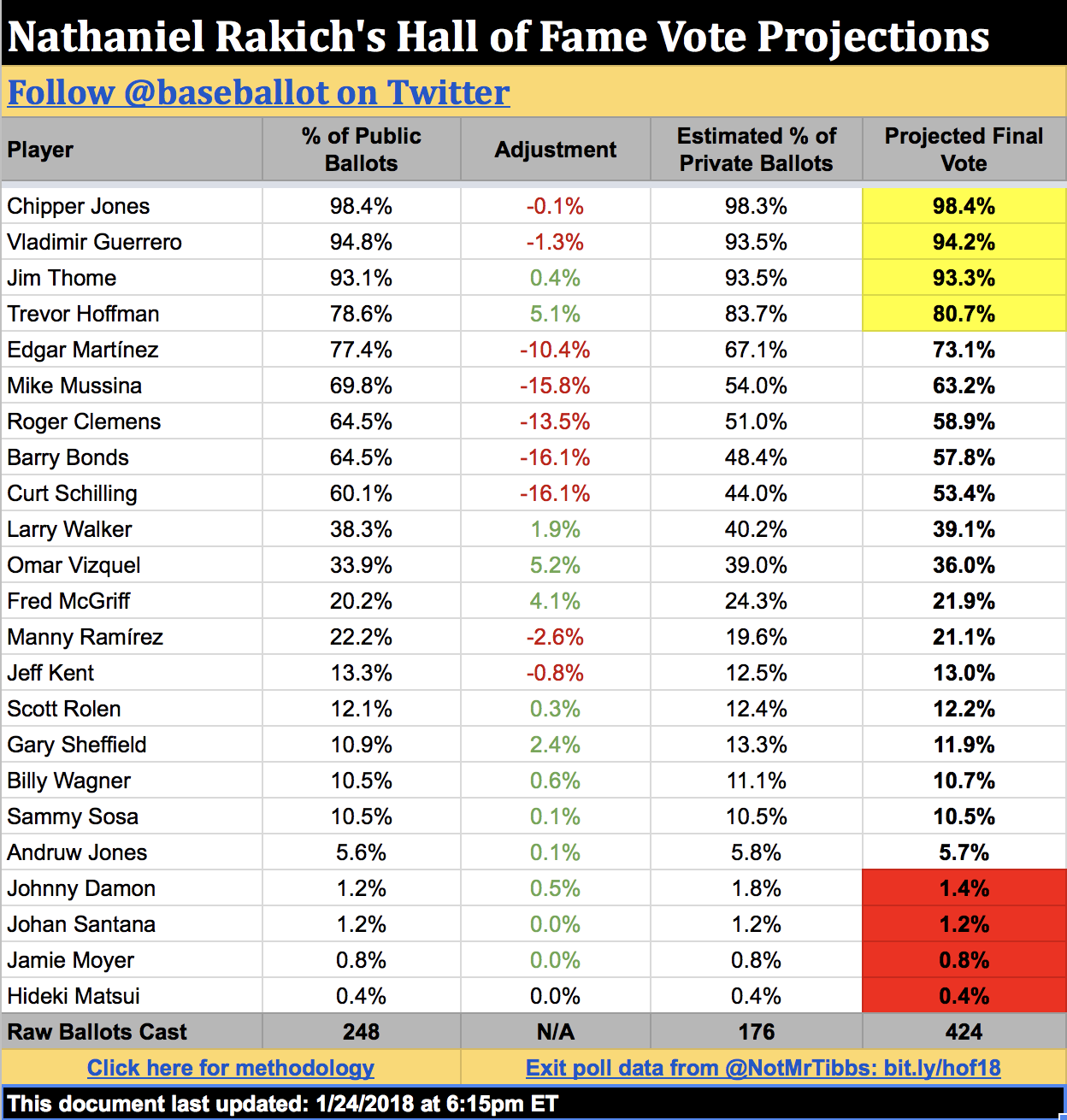
Let's take Edgar as an example. In 2017, his private-ballot performance was 16.6 percentage points lower than his public-ballot performance. In 2016, it was 7.7 percentage points lower, and in 2015 it was 6.8 percentage points lower. That averages out to an Adjustment Factor of −10.37 percentage points. As of Monday night, Martínez was polling at 79.23% in the Tracker, so his estimated performance on private ballots is 68.86%.

The final step in my model is to combine the public-ballot performance with the estimated private-ballot performance in the appropriate proportions. In the same example, as of Monday night, 207 of an expected 424 ballots had been made public, or 48.82%. If 48.82% of ballots vote for Martínez at a rate of 79.23%, and the remaining 51.18% vote for Martínez at a rate of 68.86%, that computes to an overall performance of 73.92%—just over one point shy of induction.

But my model is far from infallible. Last year, my private-ballot projections were off by an average of 4.8 percentage points—a decidedly meh performance in the small community of Hall of Fame projection models. (But don't stop reading—historically, my projections have fared much better.) Small, subjective methodological decisions can be enough to affect outcomes in what is truly a mathematical game of inches. For example, why take a straight average of Edgar's last three public-private differentials when they have been growing more and more gaping over time? (Answer: in past years, with other candidates, a straight average has proven more accurate than one that weights recent years more heavily. Historically speaking, Edgar is equally likely to revert to his "usual" modest Adjustment Factor as he is to continue trending in a bad direction.) If there's one thing that studying Hall of Fame elections has taught me, it's that voters will zig when you expect them to zag.

One of my fellow Hall of Fame forecasters, Jason Sardell, wisely communicates the uncertainty inherent in our vocation by providing not only projected vote totals, but also the probability that each candidate will be elected. His model, which uses a totally different methodology based on voter adds and drops, gives Edgar just a 12% chance of induction as of Monday night. I'm not smart enough to assign probabilities to my own model, but as discussed above, it's pretty clear from the way Edgar has seesawed around the required 75% that his shot is no better than a coin flip. Therefore, when the election results are announced this Wednesday at 6pm ET, no matter where Martínez will fall on my model, no outcome should be a surprise.

Below are my current Hall of Fame projections for every candidate on the ballot. They will be updated in real time leading up to the announcement. (UPDATE, January 24: The below are my final projections issued just before the announcement.)


(Still with me? Huzzah. There's one loose methodological end I'd like to tie up for those of you who are interested: how I calculate the vote shares of first-time candidates. This year, that's Chipper Jones, Thome, Vizquel, Scott Rolen, Andruw Jones, Johnny Damon, and Johan Santana.

Without previous vote history to go off, my model does the next best thing for these players: it looks at which other candidate on the ballot correlates most strongly with—or against—them. If New Candidate X shares many of the same public voters with Old Candidate Y, then we can be fairly sure that the two will also drop or rise in tandem among private ballots. For example, Vizquel's support correlates most strongly with opposition to Bonds: as of Monday night, just 21% of known Bonds voters had voted for Vizquel, but 49% of non-Bonds voters had. Holding those numbers steady, I use my model's final prediction of the number of Bonds voters to figure out Vizquel's final percentage as well.

Here are the other ballot rookies' closest matches:
  • Chipper voters correlate best with Bonds voters, though not super strongly, with the result that Chipper is expected to lose a little bit of ground on private ballots.
  • Thome voters have a strong negative correlation with Manny Ramírez voters, so Thome is expected to gain ground in private balloting.
  • Rolen voters correlate well with Larry Walker voters, giving Rolen a slight boost among private voters.
  • Andruw voters are negatively correlated with Jeff Kent voters; in fact, no one has voted for both men. This gives Andruw a tiny bump in private balloting.
  • It's a very small sample, but public Damon voters and public Bonds voters have zero overlap. Damon gets a decent-sized private-ballot bonus because of that.
  • Santana voters are also inclined to vote for Gary Sheffield at high rates, although small-sample caveats apply. Therefore, Santana gets a slight boost in the private projections.

Finally, anyone with one or zero public votes is judged to be a non-serious candidate. Every year, one or two writers casts a misguided ballot for a Tim Wakefield or a Garret Anderson. There's little use in trying to predict these truly random events, so all of these players—including Jamie Moyer this year—have an Adjustment Factor of zero.)

Thursday, February 9, 2017

Hall of Fame Projections Are Getting Better, But They're Still Not Perfect

You'd think that, after the forecasting debacle that was the 2016 presidential election, I'd have learned my lesson and stopped trying to predict elections. Wrong. As many of you know, I put myself on the line yet again last month when I shared some fearless predictions about how the Baseball Hall of Fame election would turn out. I must have an addiction.

This year marked the fifth year in a row that I developed a model to project Hall of Fame results based on publicly released ballots compiled by Twitter users/national heroes like Ryan Thibodaux—but this was probably the most uncertain year yet. Although I ultimately predicted that four players (Jeff Bagwell, Tim Raines, Iván Rodríguez, and Trevor Hoffman) would be inducted, I knew that Rodríguez, Hoffman, and Vladimir Guerrero were all de facto coin flips. Of course, in the end, BBWAA voters elected only Bagwell, Raines, and Rodríguez, leaving Hoffman and Guerrero to hope that a small boost will push them over the top in 2018. If you had simply taken the numbers on Ryan's BBHOF Tracker at face value, you would have gotten the correct answer that only those three would surpass 75% in 2017.

But although my projections weren't perfect, there is still a place for models in the Hall of Fame prediction business. In terms of predicting the exact percentage that each player received, the "smart" model (which is based on the known differences between public and private voters) performed significantly better than the raw data (which, Ryan would want me to point out, are not intended to be a prediction):


My model had an overall average error of 2.1 percentage points and a root mean square error of 2.7 percentage points. Most of this derives from significant misses on four players. I overestimated Edgar Martínez, Barry Bonds, and Roger Clemens all by around five points, failing to anticipate the extreme degree to which private voters would reject them. In fact, Bonds dropped by 23.8 points from public ballots to private ballots, and Clemens dropped by 20.6 points. Both figures are unprecedented: in nine years of Hall of Fame elections for which we have public-ballot data, we had never seen such a steep drop before (the previous record was Raines losing 19.5 points in 2009). Finally, I also underestimated Fred McGriff by 5.4 points. Out of nowhere, the "Crime Dog" became the new cause célèbre for old-school voters, gaining 13.0 points from public to private ballots.

Aside from these four players, however, my projections held up very well. My model's median error was just 1.2 points (its lowest ever), reflecting how it was mostly those few outliers that did me in. I am especially surprised/happy at the accuracy of my projections for the four new players on the ballot (Rodríguez, Guerrero, Manny Ramírez, and Jorge Posada). Because they have no vote history to go off, first-time candidates are always the most difficult to forecast—yet I predicted each of their final percentages within one point.

However, it's easy to make predictions when 56% of the vote is already known. By the time of the announcement, Ryan had already revealed the preferences of 249 of the eventual 442 voters. The true measure of a model lies in how well it predicted the 193 outstanding ones. If you predict Ben Revere will hit 40 home runs in 2017, but you do so in July after he had already hit 20 home runs, you're obviously benefiting from a pretty crucial bit of prior knowledge. It's the same principle here.

By this measure, my accuracy was obviously worse. I overestimated Bonds's performance with private ballots by 13.4 points, Martínez's by 11.5, and Clemens's by 9.8. I underestimated McGriff's standing on private ballots by 12.9 points. Everyone else was within a reasonable 6.1-point margin.


That was an OK performance, but this year I was outdone by several of my fellow Hall of Fame forecasters. Statheads Ben Dilday and Scott Lindholm have been doing the model thing alongside me for several years now, and this year Jason Sardell joined the fray with a groovy probabilistic model. In addition, Ross Carey is a longtime Hall observer and always issues his own set of qualitatively arrived-at predictions. This year, Ben came out on top with the best predictions of private ballots: the lowest average error (4.5 points), the lowest median error (3.02 points), and the third-lowest root mean square error (6.1 points; Ross had the lowest at 5.78). Ben also came the closest on the most players (six).


(A brief housekeeping note: Jason, Scott, and Ross only published final projections, not specifically their projections for private ballots, so I have assumed in my calculations that everyone shared Ryan's pre-election estimate of 435 total ballots.)

Again, my model performed best when using median as your yardstick; at a median error of 3.04 points, it had the second-lowest median error and darn close to the lowest overall. But I also had the second-highest average error (4.8 points) and root mean square error (6.2 points). Unfortunately, my few misses were big enough to outweigh any successes and hold my model back this year after a more fortuitous 2016. Next year, I'll aim to regain the top spot in this friendly competition!

Wednesday, January 18, 2017

Here Are 2017's Final Hall of Fame Predictions

Happy Election Day, baseball psephologists! One of the closest Baseball Hall of Fame elections in memory wraps up this evening at 6pm on MLB Network, when players from Edgar Martínez to Billy Wagner will learn whether they've been selected for baseball's highest honor.

...Except we already know that neither Martínez nor Wagner is going to get in. Each year, Ryan Thibodaux sacrifices his December and January to painstakingly curate a list of all public Hall of Fame votes so that the rest of us know roughly where the race stands. But Thibodaux's BBHOF Tracker is just that: rough. Many Hall of Fame watchers—Scott Lindholm, Ben Dilday, Jason Sardell, and yours truly—have developed FiveThirtyEight-esque election models, treating the Tracker data as "polls," to predict the eventual results. My model, which is in its fifth year, adjusts the numbers in the Tracker up or down, depending on whether a given candidate has historically under- or overperformed in public balloting. You can read my full methodology over at The Hardball Times.

With the big day upon us, it's time for me to issue my final Hall of Fame projections of 2017. While it is possible–even probable—that a couple more public ballots will be revealed before 6pm, the below numbers are accurate as of 5:55pm on Wednesday, when 250 ballots were publicly known. I will update this post as necessary leading up to the announcement.

My model started the election season optimistic—forecasting a record-tying five-player class. However, it ends the campaign predicting only four inductees: Jeff Bagwell, Tim Raines, Trevor Hoffman, and Iván Rodríguez. The other player in serious contention—Vladimir Guerrero—is projected to fall just short.

Bagwell and Raines are virtual locks for election. At a projected 83.9% and 83.5%, respectively, they are so far ahead of the required 75% that it would take a massive error to keep them out. By contrast, Hoffman and Pudge fans should be on the edge of their seats. Although their 75.9% and 76.0% projections are just over 75%, they would require only a single-point error in my forecast to put them under it instead. (This is entirely possible; no predictive model can be perfect. Last year, my model was off by an average of 1.5 points for each candidate, and in one case it was off by 3.5 points.) Hoffman's and Rodríguez's chances are better thought of as too close to call.

Guerrero is also close enough to 75% (72.3%) that he can't be ruled out for election either. As a first-year candidate, my model doesn't have much precedent to go off when making his prediction, so there is greater-than-usual uncertainty surrounding his fate. My model sees Guerrero as the type of candidate who gains votes on private ballots, but the magnitude of that gain could vary greatly. In this way, Guerrero could lift himself up over 75% without a huge amount of effort.

Perhaps the best way to think about this Hall of Fame election is to consider Hoffman, Pudge, and Vlad all as coin flips. (There's not much practical difference between having a 51% chance of winning a game and a 49% chance, even though those two sets of odds indicate different favorites.) On average, if you flip three coins, you will get 1.5 heads (well, OK, either one or two). Add that to the two virtual locks, and you're looking at an over-under of 3.5 inductees. While I am predicting four players elected, three is almost as likely.

Further down the ballot, I'm projecting Barry Bonds to reach 59.3% and Roger Clemens to reach 59.2%. Although this is well short of election, it's an astounding, nearly 20-point gain from last year's totals. If they do indeed break 50%, history bodes very well for their eventual election. Ditto for Martínez, who, at a projected 63.5%, appears to be on deck for election either in 2018 or 2019. Mike Mussina is tipped to hit 53.0% this year, also above the magic 50% threshold. He appears to have overtaken Curt Schilling as the ballot's premier starting pitcher; my model predicts Schilling will drop to 44.2% from his 52.3% showing last year.

Finally, two serious candidates are expected to drop off the ballot. The obvious one is Lee Smith, whose projected 35.3% matters less than the fact that this is his 15th, and therefore automatically last, year on the ballot. At the very bottom of my prediction sheet, Jorge Posada is currently expected to get 4.3% of the vote. Like with Hoffman/Rodríguez/Guerrero and 75%, this is well within the margin of error in terms of its closeness to 5%, the minimum number of votes a player needs to stay on the ballot. Whether Posada hangs on or not is the other major uncertainty tonight; my model currently thinks he's slightly more likely to drop off than stick around.

You can view my full projections on this Google spreadsheet or archived below for posterity. After the election, I'll write an analysis of how my (and others') prediction models did. Until then, all we can do is wait!

Thursday, January 7, 2016

What We Learned From This Year's Hall of Fame Results

I lost the coin flip.

On Wednesday night, two players—Ken Griffey and Mike Piazza—were lucky enough to join the pantheon of baseball's elite. I had predicted that Jeff Bagwell, by literally the narrowest of margins (0.1 percentage points), would join them. At that margin, though, I knew it was a coin flip, and, ultimately, Bagwell fell short.

That miss soured a great year for my overall Hall of Fame projections. The mean and median error of my projections was just 1.5 percentage points—my best mark yet in four years of doing this, and almost half the average error I experienced last year. I was also much more consistent this year, nailing eight players' percentages within one point and missing by more than three points on just one player:


Unfortunately, that one player—my biggest miss—was Bagwell: the one player whose fate was actually uncertain, and therefore the one for whom people needed Hall of Fame models the most. My off-kilter shot at him was also particularly glaring because, in a world that focuses mostly on the binary of "elected" and "not elected," I wound up on the wrong side. I can't help but feel like I failed when the one player I misled people on was the one they cared about the most.

Bagwell's showing really and truly surprised me, however. His drop from public ballots to private ballots was a whopping −11.4 percentage points—even bigger than his drop last year, which itself was uncharacteristically large for him (prior to 2015, Bagwell did about the same among public and private voters). This was even more shocking because of this year's purge of the most conservative voters from the BBWAA rolls. I was worried that my projections might prove inaccurate because they overstated drops; never in a million years did I imagine that I would understate them.

Yet I did, and not just for Bagwell. Roger Clemens and Barry Bonds also both dropped by more this year than last—again, odd, because conventional wisdom was that a lot of anti-steroid moralizers had fallen victim to the purge. Alan Trammell also dropped among private voters, despite gaining among this population last year, but I wasn't fooled; because my projections account for the last three years of public-private deviations, I correctly foresaw the direction, if not quite the magnitude, of his drop. Meanwhile, Fred McGriff did the opposite, gaining with private voters this year after suffering from them last year. (This demonstrates why, despite many suggestions that my adjustment factors rely more heavily on recent years' election results, I have stuck with a straight multi-year average.)

That said, many candidates were indeed helped by the purge. Most obviously, candidates like Bagwell, Tim Raines, Edgar Martínez, and Mike Mussina gained huge amounts of ground from last year's totals. But Mussina, Raines, and Curt Schilling were also among the players whose historically huge drops from public to private ballots were blunted a little bit this year. Their increasing acceptance with the private electorate (still a majority of voters) is crucial for their hopes of eventually being elected.

The moral of the story is that, after all that wondering we did about how the purge might affect the public-private differential, it really didn't make a huge difference. Public and private ballots ended up being purged about equally.

Other loose ends: I was worried about predicting the two new relief pitchers on the ballot, Trevor Hoffman and Billy Wagner. I needn't have been. Both ended up following the familiar reliever pattern (see Lee Smith's +11.4 public-private differential this year, which was actually smaller than expected!) of gaining votes with private voters. In fact, I should have been even more aggressive in predicting this, as they were two of the rare players my projections lowballed.

Thank you to everyone who followed along with me this Hall of Fame season, especially those who helped, encouraged, or shared my work. I want to give credit where credit is due: First, any contribution I make to the science of Hall of Fame forecasting is due entirely to Ryan Thibodaux, without whose BBHOF Tracker of public ballots none of this would be possible. I owe a lot of my record accuracy to Ryan, who this year uncovered a far greater percentage of ballots (thus reducing the possible error) than ever before. And I am hardly alone in putting out Hall of Fame forecasts every year; two other forecasters of exceptional skill include Ben Dilday and Tom Tango. Ben's median error of 1.5 percentage points this year matched my own, and Tom's was not far behind at 2.4 points, despite both basing their predictions off a smaller sample of public ballots. If you like my projections, give them some love too.

Wednesday, January 6, 2016

2016 Hall of Fame: My Final Call

It's the moment of truth for Hall of Fame watchers. Tonight at 6pm Eastern, the results of this year's election will be announced. Exit polls of over 200 ballots, dutifully collected by Ryan Thibodaux, provide hope for some candidates and great suspense for others—but they can also mislead. As I explained last week, a polling "adjustment" is necessary to arrive at final projections of Hall vote totals.

For several years, my projections, based on historical deviation between public and private ballots, have been some of the most accurate estimates around. With 208 of an estimated 450 precincts reporting, I now issue my not-quite-final-but-close-enough predictions for 2016. (I say not quite final because Ryan's ballot tracker may add handful more votes before 6pm, which I will add to my projections on this Google spreadsheet. Follow me on Twitter for real-time notifications.) In an extremely close election, I'm forecasting two players will be added to the baseball pantheon.

Ken Griffey Jr. and Mike Piazza are easy calls. At 100% and 86.1% of public ballots and projections of 97.0% and 82.0%, respectively, they have a large margin of error in case the polls for them are wrong. For a long time, I projected that they would be joined in the Class of 2016 by Jeff Bagwell, but he has been slipping steadily in the polls for the last several days. Just this morning, he passed under the 75% threshold in my projections (though he remains at 76.9% in Ryan's tracker.) However, every poll has a margin of error, and at 74.4%, my Bagwell projection is easily within that range. It's no exaggeration to say that this is the closest Hall of Fame election we've witnessed in the exit-poll era. While my model does expect him to fall just short, more fundamentally it is akin to when a polling model says an election is 50% to 50%: it's too close to call.

Tim Raines is an easier call, in my opinion. Though he is at a similar 76.0% in the exit polls, he has historically lost much more ground than Bagwell once private ballots are accounted for, with drops of −13.4%, −13.3%, and −11.5% the last three years, yielding a projected adjustment factor this year of −12.7%. Bagwell, meanwhile, has seen deviations of −10.7%, −3.5%, and +0.4% the last three years. Many observers dismiss Bagwell's chances of election this year because they expect his vote totals to drop an amount similar to Raines's, as happened last year, but I think this is a hasty assumption. Bagwell was never anathema to private voters the way Raines was until last year, meaning we should probably treat that as an outlier. This is even more true because of the purge of many of the BBWAA's most conservative voters this year. I find it unlikely that Bagwell's drop among private voters will do anything but decrease from last year's figure after this reform.

The purge is already likely responsible for the huge increases that my model predicts for Bagwell (+18.7 percentage points), Raines (+14.2 points), and many others, especially Edgar Martínez (+19.4 points), Mike Mussina (+19.5 points), and Alan Trammell (+17.5 points). These would be among the biggest year-to-year improvements in Hall of Fame history; for them all to happen in the same year is no mere coincidence. Trammell is in his 15th and final year on the ballot, so he will drop off next year regardless, but this year is poised to put not only Bagwell and Raines, but Martínez (forecast at 46.4% in his seventh year), Mussina (forecast at 44.1% in his third year), Trevor Hoffman (forecast at 64.8% in his first year), and Curt Schilling (forecast at 54.5% in his fourth year) in great position for enshrinement sometime in the future. Despite wide speculation that many of the most virulently anti-PED voters were also purged, steroid poster boys Barry Bonds and Roger Clemens are expected to gain only 5.7 and 4.3 points, respectively, from last year's totals—important boosts, but not really out of the ordinary in the historical record.

At the bottom of the ballot, I project that two notable players will drop off the ballot by failing to reach 5% support: Nomar Garciaparra and Jim Edmonds. However, both are expected to have more backing among private ballots than among public ones, and so an invisible wave of support could save either one. When dealing with such small sample sizes (an estimated 23 votes are necessary for a player to survive onto next year's ballot), a small error can make a big difference. One of my personal favorite players, Billy Wagner, is also at some risk of dropping off, although I predict he will safely hit the cutoff with 8.9%. Other than the obvious, one of the things I'm most curious about tonight is how Wagner and his fellow ballot-rookie closer, Hoffman, fare compared to their standing in the polls. I wrestled with this a lot for my projections and ended up deciding that Hoffman will overperform by about five points, while Wagner's haul would remain steady.

Below are my full projections. My full methodology can be read here. Good luck to all the candidates. NOTE: The numbers below were updated as of 5:55pm on January 6 to reflect all 213 ballots made public before the announcement. They no longer match the text above.

Saturday, January 2, 2016

How to Interpret the Polls of the 2016 Baseball Hall of Fame Election

2016 will be a year of elections—culminating with the selection of our next president, and beginning with something even more important: the Baseball Hall of Fame. On January 6 at 6pm Eastern, we'll learn which players join the pantheon of the game's best—but that doesn't mean it has to be a surprise. A healthy proportion of the Hall of Fame election's 450 votes or so are known in advance, thanks to the dogged work of Ryan Thibodaux. Ryan's addicting BBHOF Tracker aggregates ballots as they are published by their casters: the media members of the BBWAA. By Election Day, the Tracker has historically sampled as much as a third of the electorate—in essence, functioning as an "exit poll" for the referendum.

But we must be careful not to take this poll as gospel. Even the best polls carry margins of error, and Ryan will be the first to tell you that his spreadsheet represents merely data—not a projection. That's where I come in.

For the past several years, I've reweighted raw Hall of Fame data like the BBHOF Tracker's to arrive at scientific projections of the final results. Last year, my projections proved twice as accurate as the raw polls and even outperformed other prominent Hall of Fame forecasters, including one of my heroes, Tom Tango. My methodology simulates the work of political pollsters, who start by surveying the electorate but must weight these raw results using demographics, vote history, and other factors to get final, maximally accurate numbers. (This pollster "skewing" was what many Republicans, including the creator of UnskewedPolls.com, complained about in 2012 when raw data showed Romney ahead but smoothing the data gave Obama the lead—and pollsters' methods were validated when Obama, of course, won by the predicted margin.)

In the case of the Hall of Fame, a certain type of voter is more likely to "respond" to the exit poll by revealing their ballot for input in the Tracker. This median public voter is more stat-savvy, cares less about steroid use, and uses up more spots on the ballot. Editorializing a bit here, they also tend to more carefully and fairly consider their votes—a requirement that goes hand in hand with their obvious belief in the transparency of the process. Meanwhile, voters who choose to stay private tend to base their decisions on narrative, prefer stats like saves and RBI, and are more likely to invoke the character clause against PED users. They are more at peace with voting for just a few players using their own personal, subjective standards—often in patterns that seem random to the rest of us.

To account for the exit poll's oversampling of so-called "progressive" BBWAA members, we have to adjust the raw data for each player up or down. Comparing past exit polls with the final results, it's plain that candidates such as Tim Raines, Barry Bonds, and Curt Schilling are consistently overstated by the polls, while players like Lee Smith, Larry Walker, and Nomar Garciaparra are lowballed by them. I use these historical deviations to come up with an exit-poll "adjustment factor" for each player returning to the ballot (for first-time candidates, calculating the adjustment factor is more complicated—see below). Then, I simply add or subtract each player's adjustment factor to or from his percentage in the BBHOF Tracker to arrive at my projections.

Below are the current projections along with their underlying numbers. To reflect the new polling data that Ryan collects on a rolling basis, I'll update these projections daily on Twitter and in this Google spreadsheet until the results are announced. These projections—and the polls—get more accurate for each additional ballot released. UPDATE: These are my final projections, issued at 5:55pm on January 6.


For those of you who are interested in the exact methodology of these projections, read on. To calculate the adjustment factor for returning players, I took a straight average of each player's differential between public and private ballots over the last three years. For example, Mike Piazza's differential was −9.8% in 2015, −9.1% in 2014, and −3.8% in 2013, so his adjustment factor is −7.6%. Importantly for drawing the distinction between public and private ballots, in order to best simulate the pre-announcement conditions we're working under, I only care about which ballots were public before results were released. Therefore, I use Darren Viola's now-defunct HOF Ballot Collecting Gizmo rather than Ryan's spreadsheet for these historical numbers. (All historical exit-poll data can be found in this spreadsheet.) For players who have only been on the ballot for two years or one year, I take the straight average of their public-private differentials for however long they've been on the ballot. Ergo, Mike Mussina's adjustment factor is the average of his −16.8% from 2015 and his −10.2% from 2014, and Gary Sheffield's is simply just his 2015 differential of +3.0%.

As explained above, I then add or subtract each player's adjustment factor to or from his percentage in the BBHOF Tracker to arrive at an estimate for how this year's private ballots will treat him. Then I combine the private and public counts proportionally based on how many public ballots are known and how many private ballots are expected. Because of last year's purge of the Hall of Fame voter rolls, lower turnout is expected this year: Hall watchers generally agree that about 450 of the now-475 eligible voters will cast ballots. Therefore, if there are 200 public ballots, my projections assume 250 private ballots will be cast. To take an example, if a player is at 30% among public ballots but I project him at 45% among private ones, I would combine those proportionally at a four-to-five ratio (i.e., 200/250) for a final vote projection of 38.3%. This is why, as public ballots become a greater and greater share of the total electorate, my projections get ever closer to the raw polls.

This leaves the ballot's first-time candidates—Ken Griffey, Trevor Hoffman, Billy Wagner, Jim Edmonds, and several non-serious candidates—to reckon with. Because they don't have any vote history of their own to go off, I use the next best thing—the vote history of similar candidates. The polls also allow us to see what kind of voter best correlates with Hoffman voters, Wagner voters, etc., in a phenomenon similar to genetic linkage; if certain candidates are regularly paired up, they probably share the same type of supporter. Sam Miller identified three general strains of voter (think of them as political parties) in an analysis earlier this year; it's the same concept.

The returning candidate most closely correlated with Hoffman is Smith. This is not exactly a shock. The two candidates are extremely similar: they are both relief pitchers, and the best argument for their induction is their prodigious saves totals. The type of voter who would be swayed by saves, and who rejects sabermetric arguments that relief pitchers are not valuable because of how many fewer innings they pitch than starters, would be expected to vote eagerly for Hoffman and Smith in equal measure. Indeed, as of January 2, 88.4% of public Smith voters voted for Hoffman, while just 51.5% of public non-Smith voters did. Meanwhile, 43.2% of public Hoffman voters voted for Smith, while just 9.6% of public non-Hoffman voters did. That's as strong a correlation as you'll find this side of Bonds and Roger Clemens.

Rather than devise an adjustment factor for Hoffman, I calculate his estimated share of private ballots directly under the assumption that the same percentages of Smith voters and of non-Smith voters support Hoffman across the board. For instance, as of January 2, Smith's estimated performance on private ballots was 43.4%; 88.4% of those 43.4% are assumed to support Hoffman, and 51.5% of the remaining 56.6% do too—yielding a private-ballot haul of 67.5% for Hoffman. Once his private performance is calculated, I combine it with his public votes in the same way as every other candidate to get a final projection.

I follow the same logic with Wagner. The lefty is an odd case; he is a relief pitcher, which means it is hard to get new-age voters to take his candidacy seriously—but his Hall of Fame case, less reliant on saves and more on strikeouts and win probability added, is best appreciated with the use of advanced metrics. That leaves him in no-man's land; in political terms, he lacks a true base. He does not correlate especially well with Hoffman and Smith voters, who disdain his smaller number of saves. But he also does not correlate with stathead favorites like Schilling or Jeff Bagwell. It turns out that his closest relationship is an inverse one with three misfit sluggers: Mark McGwire, Sheffield, and Sammy Sosa. In fact, it's a perfect relationship: so far in public ballots, no one who has voted for one of these three men has also voted for Wagner. Because they are the largest sample size, I used McGwire voters and non-McGwire voters to calculate Wagner's popularity on private ballots, but the results are very similar if you use Sheffield or Sosa instead.

We come to a problem when we try to apply this technique to Griffey and Edmonds, however. So far, Griffey is the unanimous choice of public ballots—so a linkage analysis is useless. One hundred percent of everybody's voters voted for Griffey, and there are no non-Griffey voters whose preferences to survey. Edmonds, meanwhile, has the opposite problem—he has scrounged up just four public votes so far, not a big enough sample size to extrapolate from. For these two, then, I had to calculate adjustment factors a different way: by looking back at past candidates to find a good analog.

Griffey is a well-liked, PED-free superstar with an undeniable statistical case for the Hall. How have those types of first-time candidates fared in the last few years? Randy Johnson slipped −2.0% from public to private. Pedro Martínez lost −10.4%. John Smoltz's factor was −5.5%. Greg Maddux's was −3.6%, Tom Glavine's was −5.9%, and Frank Thomas was −8.3%. In 2013, his first year on the ballot, Craig Biggio went down −2.9%. Clearly, there are some voters who are simply ignorant, contrarian, or both. They cause Griffey-esque candidates to fall an average −5.5%—so that's his adjustment factor.

Edmonds, meanwhile, was a hard-nosed competitor with a gaudy reputation but stats that are much less obviously Hall-worthy. So far, the electorate appears to be treating him similarly to the glut of borderline candidates swimming against the tide to avoid the 5% elimination threshold. In their first years on the ballot, comparable players Garciaparra (+5.6%), Carlos Delgado (+3.7%), Sheffield (+3.0%), Jeff Kent (−0.9%), and Sosa (−1.4%) mostly gained votes from private balloters. I took their average of +2.0% as Edmonds's adjustment factor.

Finally, I've judged Garret Anderson (who, yes, has actually gotten one public vote so far), Jason Kendall, and the other clear long shots to be non-competitive—that is, they won't get more than a handful of throwaway votes, as happens every year for the ballot's weakest links. (Aaron Boone got two votes last year!) Because there's little point in trying to predict whether Mike Lowell will get one vote or two, everyone in this category simply has an adjustment factor of zero.

These methods have served me well in the past. But this year is an exceptional one because of the unknown effect of the purge of the voter rolls. How much of a wrench will it throw into my work? We already know that the purge will drastically change turnout this year, and estimating turnout accurately is important to my methodology. The initial guess of 450 seems logical, but really we have no idea—and we don't have precedent to back that estimate up. It's also very possible that the purge fundamentally altered the difference between public and private voters. Many have speculated that conservative private voters were disproportionately purged—the retired baseball writers who no longer have a newspaper column (or are too old-fashioned to have a Twitter account) with which to share their ballots. This could mean that the remaining stock of private ballots resembles the public snapshot a lot more closely than in years past. On the other hand, we know of plenty conservative, formerly public voters who were purged this year. Maybe the purge affected both public and private equally, and the adjustment factors will largely hold up.

I admit I'm unsure. But I know better than to construct a new methodology based entirely on theoretical suppositions rather than one that has been proven accurate in the past. I'm bracing myself for unpredictability, and, once known, the effects of the purge may cause me to tweak my methodology next year. But for now, I'm sticking with what I know.

Friday, December 18, 2015

In Search of the Mathematically Best Hall of Fame Ballot

I'm not a voter for the Baseball Hall of Fame; not even close. But if you are, I'm writing this for you. I'm not here to tell you whom to vote for or how to judge players you've covered and worked with for decades. But, coming from the world of politics and elections, there is one thing that we psephologists can tell you: how vitally important it is to cast your ballot strategically.

The bane of many Hall of Fame voters is the 10-candidate voting limit. Many voters believe this year's ballot is absolutely stacked with deserving candidates—possibly up to 15 or 20. Yet they're forced to choose which worthy players to vote for and which to drop off the ballot—actively punishing their chances of election. This, in a word, sucks, and it's led to several efforts at reform, yet the 10-vote limit remains in place.

Hall of Fame voters: there are many logical pathways to deciding who to cut from your list. Many of you simply vote for the 10 worthiest players in your eyes. Please don't do this. Instead, vote in such a way that maximizes the value of your ballot. Vote for the players who really and truly need your vote. In other words, vote strategically.

There's a lot of resistance to casting a strategic ballot; it seems perverse to vote for a guy you think is on the bubble ahead of someone you think should be a slam dunk. I agree, it's shameful—but so is the voting process as it is. Capping the number of qualified candidates instead of asking, say, a simple yes/no for each player is a balloting system that's here to stay, and it's your job, as a voter, to navigate it. Here, today, in this election, where the rules are already set, you have two choices: you can vote strategically and make a real difference to a player whose enshrinement you believe in (either by pushing him over the top or, more likely, preventing him from falling off the ballot)—or you can selfishly vote in a way that makes you feel morally secure but have it not matter because your votes don't change the outcome one iota.

Strategic voting feels dirty, but it's actually a crucial part of a functioning democracy. Many of us vote strategically all the time in political elections. Are you a Republican who really prefers Lindsey Graham but also wants to keep Donald Trump from being the nominee? Chances are you'll vote for someone like Marco Rubio this spring because he has a better shot at topping Trump. Are you an environmental activist living in Florida who really loves the Green Party? You're probably better served voting for the Democrat in order to prevent your least favorite candidate, the Republican, from winning. (Green Party voters in Florida would have been smart to remember this fact in 2000!) Far from corrupting the process, strategic voting allows the candidates who truly appeal to the broadest cross-section of the electorate to prevail. (Besides, in the case of the Hall of Fame—and, perhaps, political elections—the process was already corrupted by the powers that be long before you arrived on the scene to fill out your ballot.)

Thanks to pre-election polling by Ryan Thibodaux, we know who is near the magic thresholds of 75% (election) and 5% (elimination) and thus have information on which to base a strategic vote for the Hall of Fame. Accordingly, here is your step-by-step guide to choosing the 10 players who will make your vote the most meaningful.
  1. Write down all the players you believe are worthy of the Hall of Fame. Don't limit yourself to 10; list them all. Got it? Good.
  2. Cross out the following names, if they appear on your list: Ken Griffey Jr., Barry Bonds, Roger Clemens, Curt Schilling, Lee Smith, Edgar Martínez, Alan Trammell, Mike Mussina, and Mark McGwire. Griffey is going to be elected, full stop. It's safe to leave him off your ballot. (If you are worried about what would happen if everyone else did the same thing, don't be. You know as well as I do that only a handful of voters, if that, will vote strategically in this way. Everyone else is too hesitant. Besides, Thibodaux's polling shows that he is hardly in any danger.) Trammell and McGwire are on their last year on the ballot; they will drop off after this year no matter what, and neither is anywhere close to election. Their votes are better used elsewhere too. Finally, Bonds, Clemens, and the rest are stuck in Hall of Fame purgatory between 25% and 50% of the vote. They are in no danger of falling below 5%, and they are incapable of reaching 75%. It doesn't matter whether Bonds gets 37% of the vote or 38%. Don't waste a vote on him.
  3. Fill out your ballot with the remaining names on your list. This will include Mike Piazza, Jeff Bagwell, Tim Raines, and/or Trevor Hoffman, the four candidates who are hovering around 75% in polls. They have a realistic chance at election this year and therefore need your votes the most. It may also include underappreciated candidates like Larry Walker, Billy Wagner, Jim Edmonds, Sammy Sosa, Gary Sheffield, Fred McGriff, Jeff Kent, or Nomar Garciaparra. While there is a case to be made for all of these candidates—indeed, chances are decent that you support at least one of them for election—they are all at risk of totaling less than 5% of the vote. With this year's projected turnout of 450, all it takes is 23 votes to keep each of these candidates alive. This is the place where your vote can make the most difference, and yet, because these guys are the less obvious Hall of Famers, it's also the place where most voters start their cutting when they decide to vote for only the 10 players with the best stats.
  4. Fill in the remaining slots on your ballot (up to 10 total) with the crossed-out names of your choosing. Chances are very good that, after Step 3, your ballot has less than 10 names on it. Yet it is important to fill your ballot up to the maximum—if only to show the Hall of Fame that the 10-vote limit is still restrictive and that they must address this backlog of qualified candidates. You can choose any of the names you crossed off, for any reason—as we've established, votes for these candidates don't matter other than for symbolic reasons. You can decide to vote for the best-qualified remaining candidates, you can decide to make a statement (say, for or against steroids users), or whatever you prefer.
So how about an example? Here's how I would vote if I had a ballot.

I take an inclusive interpretation of the Hall of Fame. As far as I'm concerned, anyone whose stats come close to measuring up to other Hall of Famers is welcome to join. Therefore, on this year's ballot, there are no fewer than 18 candidates I'd support for enshrinement. For my Step 1, here they are, in order from easiest call to most borderline:
  1. Barry Bonds
  2. Roger Clemens
  3. Ken Griffey
  4. Jeff Bagwell
  5. Mike Piazza
  6. Curt Schilling
  7. Mike Mussina
  8. Tim Raines
  9. Alan Trammell
  10. Mark McGwire
  11. Larry Walker
  12. Edgar Martinez
  13. Billy Wagner
  14. Trevor Hoffman
  15. Lee Smith
  16. Jim Edmonds
  17. Sammy Sosa
  18. Gary Sheffield
(Extremely honorable mentions go to Fred McGriff and Jeff Kent, who I supported last year and who are right on the cusp for me; Nomar Garciaparra, whose insane peak makes the 11-year-old inside me so desperately want to vote for him; and Jason Kendall, who is no one's idea of a Hall of Famer but accrued enough quality at-bats at the game's toughest position to put himself in the conversation.)

These names are whom I voted for in the Internet Baseball Writers Association of America's (IBWAA) simulated Hall of Fame election (the IBWAA has a ballot limit of 15, and it has already "elected" Bagwell, Piazza, and Raines in years past, so the numbers work out perfectly). But in a real Hall of Fame election, I'd have to make several cuts. Let's follow Step 2 and eliminate those nine names. I'm left with a ballot of nine:
  • Jeff Bagwell
  • Mike Piazza
  • Tim Raines
  • Larry Walker
  • Billy Wagner
  • Trevor Hoffman
  • Jim Edmonds
  • Sammy Sosa
  • Gary Sheffield
However, per Step 4, I need to add one more name. Let's make it Alan Trammell and give him a good sendoff from the ballot. Hopefully the Veterans Committee will take note and elect him someday. Therefore, if I were a Hall of Fame voter, here is the mathematically best ballot I could submit:
  • Jeff Bagwell
  • Jim Edmonds
  • Trevor Hoffman
  • Mike Piazza
  • Tim Raines
  • Gary Sheffield
  • Sammy Sosa
  • Billy Wagner
  • Larry Walker
  • Alan Trammell
That doesn't have to be your ballot. It probably won't be. But here's hoping you come to your ballot via the same sound logic. Good luck, and happy voting.